

Last updated: July 2026 · By Muhammad Arif Hussain, DGSoftHub
Most people trying to learn digital marketing for beginners quit within the first month — not because the work is hard, but because nobody told them what to actually focus on first. If you’ve opened ten tabs, watched a dozen YouTube videos, and still don’t know where to start, you’re not the problem. The advice out there is.
Here’s the good news: you don’t need a marketing degree, a big budget, or fancy software to get moving. You need one skill, a bit of patience, and a roadmap that doesn’t overcomplicate things. That’s what this post is.
What this post covers: what digital marketing actually is, the five channels worth your time in 2026, and a realistic step-by-step plan to start earning from it — even with zero investment.
What Is Digital Marketing? (A Beginner’s Definition That Actually Makes Sense)
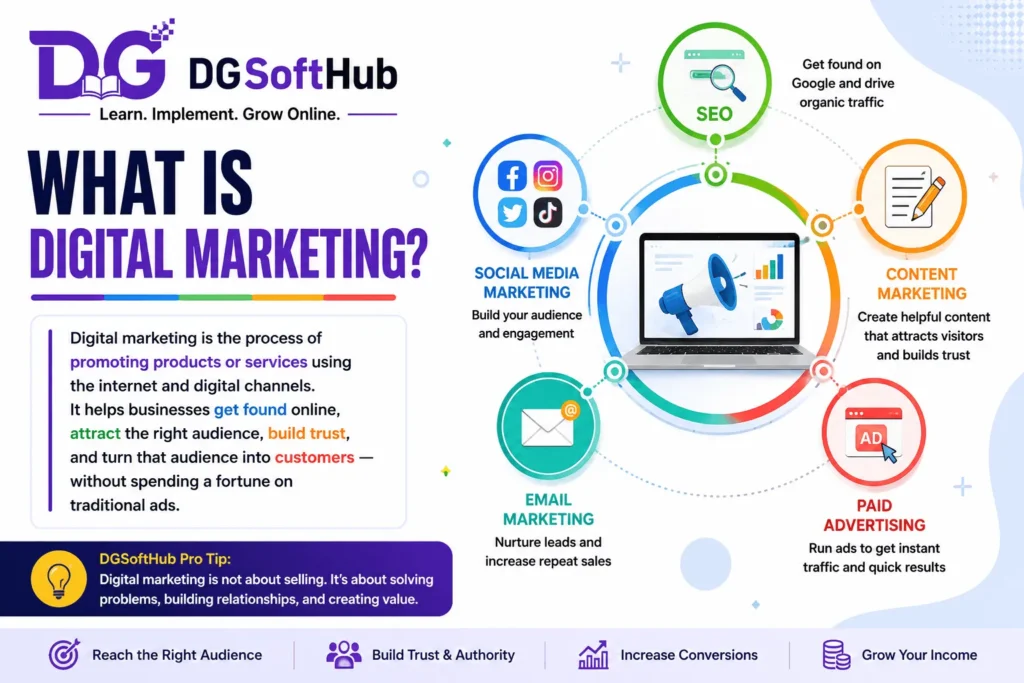
Strip away the jargon and it’s simple: digital marketing is promoting a product or service using the internet instead of TV, print, or billboards. Google search, social media, and websites do the job traditional ads used to do — except cheaper, faster, and trackable down to the click.
In plain terms: digital marketing = getting paid to help businesses (including your own) get found online.
I’ve noticed many beginners spend weeks overthinking this definition instead of practicing. Don’t. You’ll understand it much better once you start applying it.
Why Digital Marketing for Beginners Is Exploding in 2026
Millions of businesses now rely on search engines, social media, and online advertising to reach customers, creating steady demand for digital marketing skills. More people are online than at any point in history, every business needs a digital presence to survive, and freelancing platforms have made it normal to hire someone you’ll never meet in person. Add remote work becoming permanent for millions of people, and you get a field with more entry points than almost any other career path.
- Bigger audience: more internet users than any previous year, which means more searches, more buyers, and more attention up for grabs.
- No online presence = invisible: businesses that skip digital marketing are quietly losing customers to competitors who don’t.
- Freelancing keeps growing: clients hire skill, not location, which levels the playing field for beginners in any country.
- Work-from-anywhere is normal now: no office, no commute, no dress code — just a laptop and internet connection.
Put simply, digital marketing for beginners isn’t a trend chasing hype — it’s a shift that already happened. You’re just catching up to it.
The Core Types of Digital Marketing You Need to Know
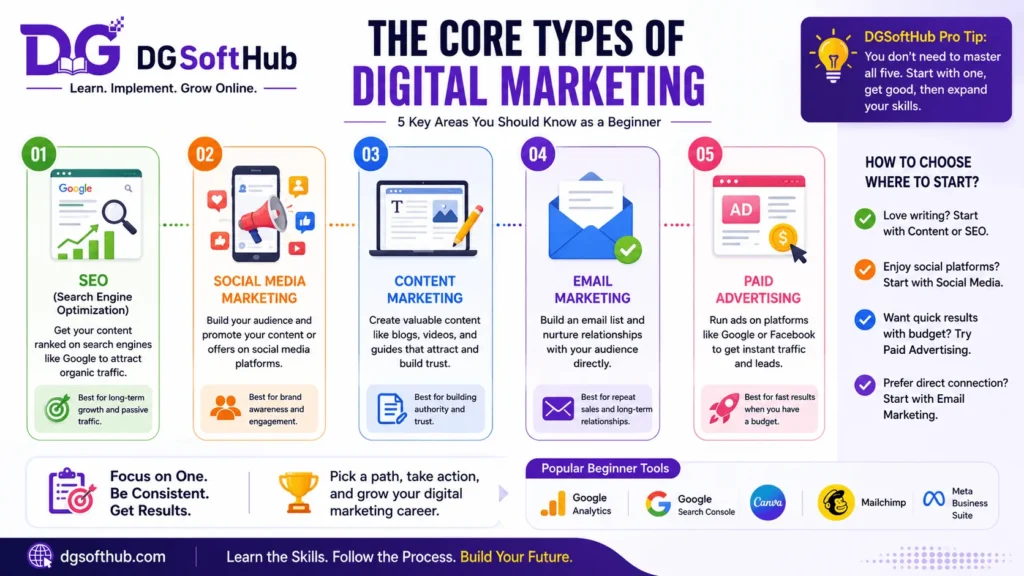
You don’t need to master all five of these. Pick one, get good, then expand. Trying to do everything at once is the fastest way to do nothing well.
1. SEO (Search Engine Optimization)
SEO gets your content ranked on Google so people find you without ads. Someone searches “what is digital marketing,” and if you’ve done SEO right, your blog shows up in the results. It’s slow to start and compounds hard over time — which is exactly why most beginners give up on it too early.
2. Social Media Marketing
Building an audience and promoting on platforms like Instagram, Facebook, or TikTok. Fast feedback loop, low barrier to entry, but algorithms change constantly — so what works this month might flop next month.
3. Content Marketing
Creating blogs, videos, or guides that genuinely help people. This is the trust-builder. Nobody buys from a stranger; content is how you stop being a stranger.
4. Email Marketing
Still one of the highest-ROI channels there is. You own your email list — you don’t own your social media followers, since a platform ban can wipe that out overnight.
5. Paid Advertising
Running ads on Google or Facebook to get instant traffic. Effective, but it costs money, and beginners often burn budget before learning how targeting actually works. Learn one free channel first.
Digital Marketing Channels Compared
If you’re still deciding where to start, this is the side-by-side view I’d show a beginner before they pick a lane.
Channel | Cost to Start | Time to See Results | Beginner Difficulty | Best For |
SEO | Free | 3–6 months | Medium | Long-term, compounding traffic |
Social Media Marketing | Free (or low budget for boosting) | Weeks | Easy | Fast feedback and audience building |
Content Marketing | Free | 2–4 months | Medium | Building trust and authority |
Email Marketing | Free–low cost (email tool) | 1–3 months | Easy–Medium | Owning your audience long-term |
Paid Advertising | Requires ad budget | Days | Hard for beginners | Fast traffic once you have a budget |
If you want traffic fast and don’t mind paying for it, start with ads. If you’re patient and broke — which most beginners are — SEO or content marketing will serve you better long-term.
How Digital Marketing Actually Works (The Real Process)
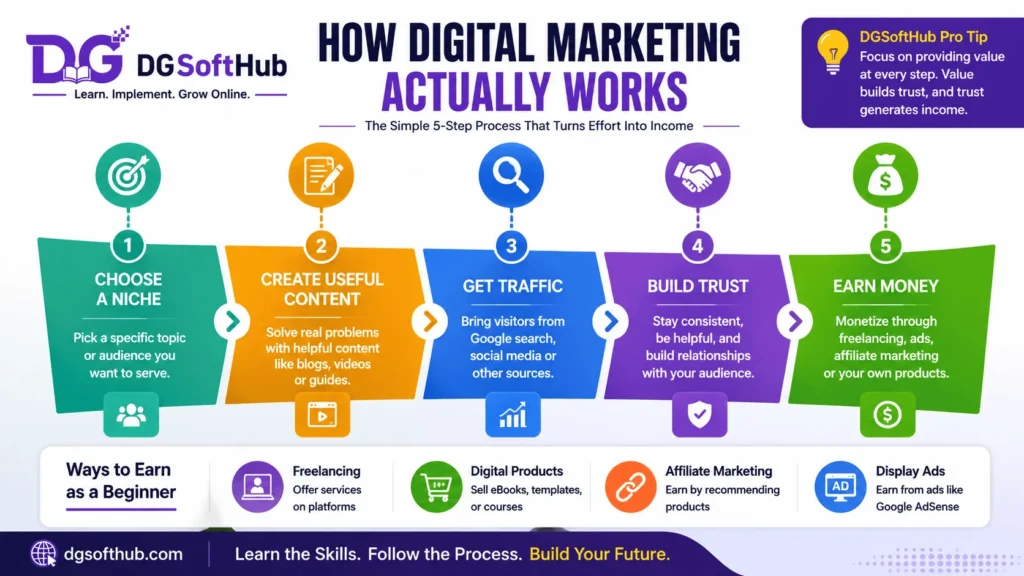
Here’s where things usually get overcomplicated. Strip it down and the process looks like this:
- Choose a niche: something specific enough that you’re not competing with every marketer alive.
- Create useful content: solve a real problem someone is searching for, not just filler for the sake of posting.
- Get traffic: from Google, social platforms, or both — this is where SEO and social media marketing earn their keep.
- Build trust: consistency and honesty do this faster than any “growth hack.”
- Earn money: through freelancing, ads, affiliate links, or selling your own product.
This is the part nobody talks about: the order matters. Skip “build trust” and jump straight to “earn money,” and you’ll burn an audience before you’ve built one.
Ready to Put Digital Marketing Into Practice?
Reading about digital marketing is a good start. The next step is having a clear system to follow.
Digital Marketing for Beginners — Complete 2026 Roadmap gives you a practical path from learning the fundamentals to taking action, finding opportunities, and building your online career.
Your purchase includes:
- 📘Digital Marketing for Beginners — Complete 2026 Roadmap
A practical beginner-friendly guide with exercises, worksheets, and a 90-day action plan. - 🧰SEO Success Toolkit — 2026
An 8-module implementation workbook for turning SEO knowledge into a repeatable workflow. - 🔎Google Search Console Action Checklist — 2026 Edition
A practical checklist for monitoring and improving your site’s search performance.
One purchase. Three practical resources.
$19 — Instant digital access
*Learn. Implement. Grow Online.*
Digital Marketing for Beginners: A Step-by-Step Roadmap
This is the sequence I’d tell a friend to follow if they were starting from zero today.
Step 1: Learn the Basics for Free
YouTube channels, free blogs, and beginner courses will cover 80% of what you need. Don’t pay for anything yet.
Step 2: Choose One Skill
Pick SEO, freelancing, or social media — not all three. Depth beats breadth when you’re starting out.
Step 3: Practice Daily, Not Occasionally
Start a blog or a social page and post consistently. Most beginners skip this step entirely and go straight from “learning” to “expecting results,” which never works.
Step 4: Use Free Tools Before Paid Ones
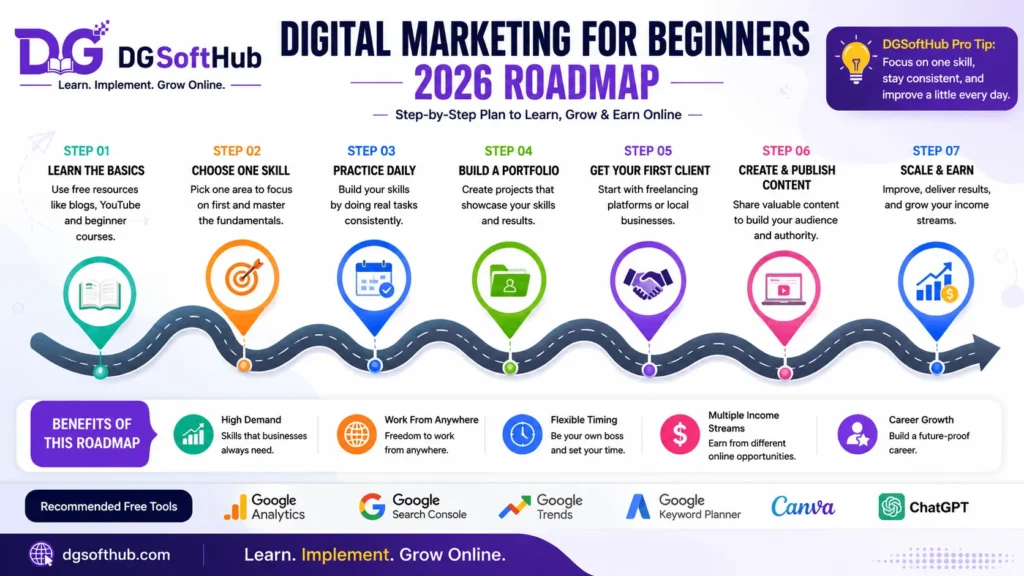
Canva for creating graphics, Google Analytics for understanding your visitors, Google Search Console for monitoring your website’s performance in Google Search, Google Trends for discovering popular topics, and Google Keyword Planner for basic keyword research. If you use AI, ChatGPT can also help you brainstorm ideas, create outlines, and overcome writer’s block—but always review and personalize the output before publishing.
DGSoftHub tip: once you’re generating consistent traffic, paid tools like SEMrush or Ahrefs for keyword research become worth the cost — not before. Upgrading too early just drains a budget you don’t have income to support yet.
Step 5: Start Earning
Freelancing, digital products, affiliate marketing, or ad revenue through something like Google AdSense. Most beginners combine two of these once they’ve got traction.
Can You Start Digital Marketing With Zero Investment?
Yes — genuinely. All you need is an internet connection, a laptop or phone, and enough patience to not quit in week three. You can even begin using free platforms such as WordPress.com, Blogger, or Google Sites while you’re learning. As your skills and income grow, you can later move to your own domain and web hosting without losing the experience you’ve gained.
How Long Before You Start Earning From Digital Marketing?
Realistic timelines, not the “get rich in 30 days” nonsense you’ll see elsewhere:
- Month 1–2: getting comfortable with your chosen skill and platform.
- Month 2–4: your first client, first sale, or first ad payout — usually small.
- Month 6+: this is where digital marketing starts feeling like a real income stream.
Patience is the actual skill here. The tactics matter less than most guides admit.
Common Mistakes Beginners Make (And How to Avoid Them)
After going through this process myself and watching dozens of beginners go through it too, the same three mistakes show up over and over. In practice, what this looks like is someone learning five skills half-way instead of one skill fully, chasing algorithm hacks instead of building an actual audience, and quitting right around month two — which, ironically, is usually just before things start working.
- Skill-hopping: switching from SEO to social media to email marketing every few weeks instead of sticking with one.
- Content without research: posting content nobody searched for or asked about, just to “stay active.”
- Spending before earning: buying paid tools or courses before validating that the free version of the skill even works for you.
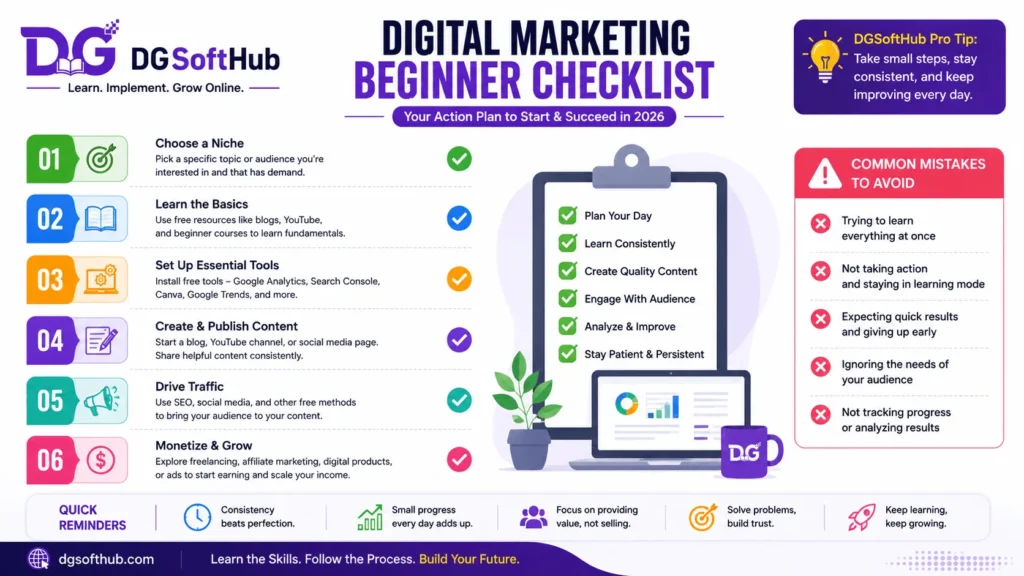
Your Digital Marketing for Beginners Checklist
Bookmark this part. It’s the whole roadmap condensed into something you can actually tick off.
- Learned the basics — watched or read enough to understand the five core channels.
- Chosen one skill to focus on — SEO, social media, content, email, or paid ads — and written it down.
- Picked a niche — picked something specific enough that you’re not competing with everyone.
- Set up free tools — Canva, Google Analytics, Google Search Console, and Google Trends.
- Published your first piece of content — blog post or social page, live and public.
- Stayed consistent for 30 days — without switching channels or giving up.
- Landed your first bit of income — client, sale, or ad payout, however small.
- Considered paid tools — only once the free version of your skill is already working.
If you can’t check off the first three yet, stop reading roadmaps and go do those first. Everything else builds on them.
Related Guides You May Find Helpful
If you’re ready to learn more, these beginner-friendly guides will help you build your digital marketing skills step by step:
- How to Learn Digital Marketing at Home for Free (Beginner Guide)
- Best Digital Marketing Skills to Learn in 2026
- How to Start Digital Marketing with Zero Investment
- SEO Basics: Step-by-Step Guide to Rank on Google
- Best Free Tools for Digital Marketing Beginners (2026 Guide)
- How to Write SEO-Friendly Blog Posts
- How to Start a Blog and Make Money (Beginner Guide 2026)
- How to Get Traffic to a New Blog (No Experience Needed)
- How to Find Low-Competition Keywords (Beginner Guide)
- Best SEO Tools for Beginners in 2026
- How to Make Money with Digital Marketing
Extra: Beginner Starter Kit (Digital Marketing for Beginners)
If you are a beginner looking for a fast start with digital marketing, you should look no further because we have compiled a Digital Marketing Starter Kit which includes:
Fiverr Templates
Message for clients
Roadmap for beginners
List of free tools
Want ready-made Fiverr templates and client messages? Save hours of work with this free starter kit
FAQ: Digital Marketing for Beginners
Is digital marketing still worth learning in 2026?
Yes. Businesses need an online presence more than ever, and the demand for people who can build one — SEO, content, social, ads — hasn’t slowed down.
Which digital marketing skill is easiest for a total beginner?
Social media marketing usually has the lowest barrier to entry, since you can start posting immediately. SEO takes longer to show results but compounds better long-term.
Do I need a degree to work in digital marketing?
No. Many successful digital marketers are self-taught through free resources, online courses, and hands-on practice rather than formal degrees.
How much money do I need to start digital marketing?
You can genuinely start with zero investment using free tools like Canva, Google Analytics, and a free blog platform. Paid tools become useful later, not at the start.
How long does it take to make money from digital marketing?
Most beginners spend 1–2 months learning, see their first earnings around month 2–4, and reach more consistent income after 6 months of steady effort.
What’s the biggest mistake beginners make in digital marketing?
Trying to learn every channel at once instead of getting good at one first. Depth beats breadth, especially in the first few months.
Can I do digital marketing as a side hustle while working a full-time job?
Yes, and many people do exactly that. It just means your timeline to consistent income will stretch out a bit further than someone working on it full-time.
What You Should Do Next
- Pick exactly one skill today: SEO, social media, or freelancing. Write it down. Don’t revisit this decision for at least 30 days.
- Start a blog or social page this week: choose a niche you can talk about for 3 months without getting bored of it.
- Set up two free tools: sign up for Canva and Google Analytics — no purchases needed yet.
- Publish consistently for 30 days: Whether that’s daily or a few times each week, focus on building the habit instead of chasing perfection.
- Revisit paid tools in month 3, not month 1: only after you’ve validated a free version of your chosen skill.
Digital marketing isn’t about finding a shortcut—it’s about building skills that become more valuable over time. Start with one skill, stay consistent, and focus on helping real people solve real problems. Six months from now, you’ll be glad you started today.
Want the Complete Roadmap?
If you’re ready to move from reading to implementation, get the Digital Marketing for Beginners — Complete 2026 Roadmap plus the SEO Success Toolkit and Google Search Console Action Checklist.
$19 | Instant PDF access
About the Author
Muhammad Arif Hussain is the founder of DGSoftHub, where he writes beginner-to-intermediate guides on digital marketing, SEO, freelancing, and AI-assisted content tools. His guides are based on hands-on experience building DGSoftHub, publishing SEO-focused content, and testing practical digital marketing strategies that beginners can apply.
DGSoftHub | Learn. Implement. Grow Online. | dgsofthub.com
Hi, this is a comment.
To get started with moderating, editing, and deleting comments, please visit the Comments screen in the dashboard.
Commenter avatars come from Gravatar.
[…] Learn basics: “What is Digital Marketing” […]
[…] “What is Digital Marketing” […]
[…] What is Digital Marketing […]
[…] What is Digital Marketing […]
[…] What is Digital Marketing […]