
updated: July2026
estimated reading time: 07 to 12 minutes
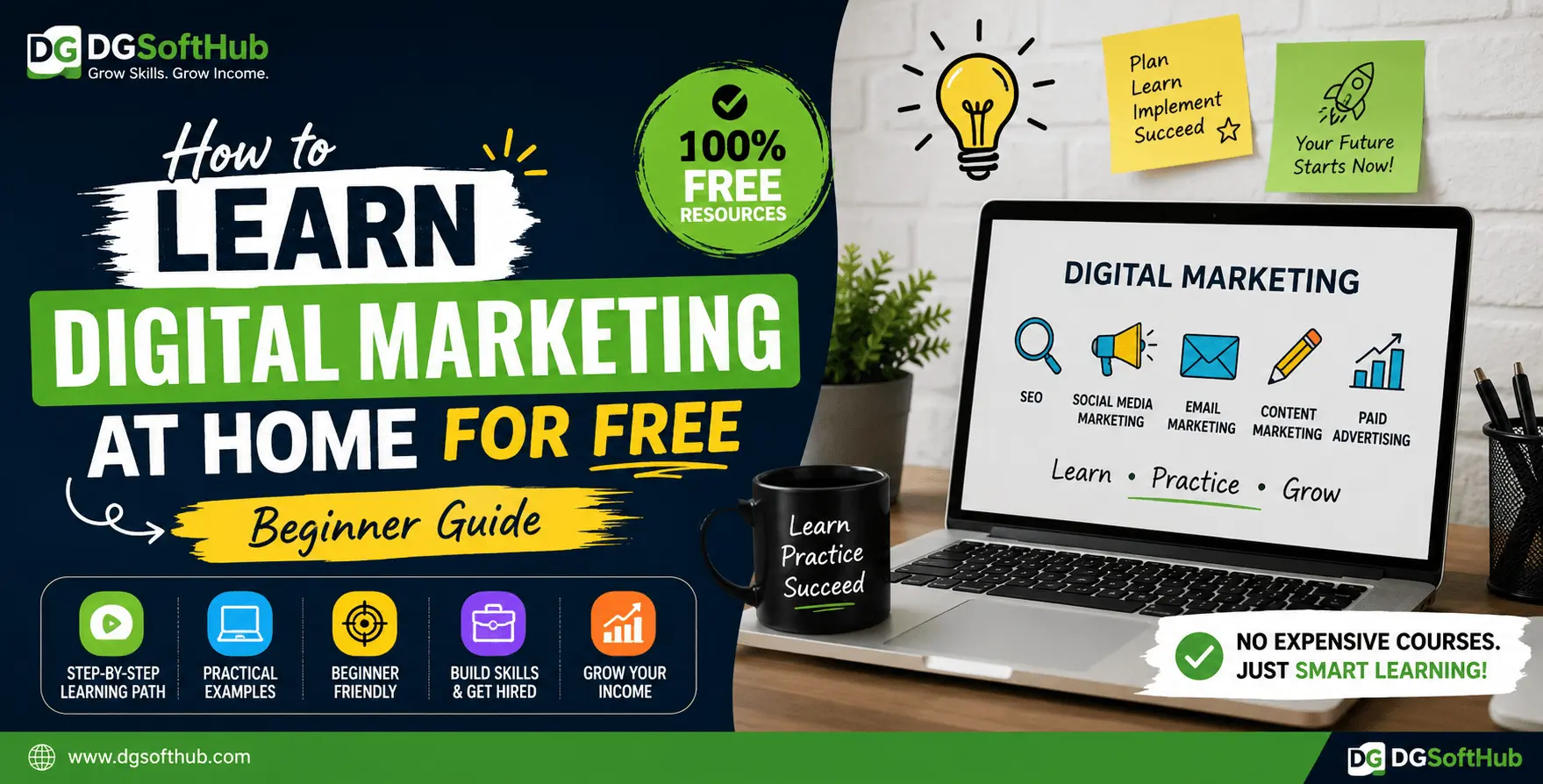
You don’t need a Rs.40,000 course to learn digital marketing at home for free. You need a laptop, an internet connection, and about two hours a day — and honestly, most people already have all three and still don’t start.
Here’s what this post covers: a realistic, step-by-step way to learn digital marketing from home without spending a rupee, based on what actually works versus what just sounds good on YouTube thumbnails.
Can You Really Learn Digital Marketing for Free?
Yes. Flat out, yes. I’ve watched people go from zero knowledge to landing their first paid client in under four months using nothing but YouTube, free blogs, and stubborn consistency.
That said, “free” doesn’t mean “effortless.” Free resources exist in abundance — the real bottleneck is almost never access. It’s follow-through.
Here’s why free learning works for digital marketing specifically:
- The tools have free tiers. Canva, Google Analytics, Google Search Console, Ubersuggest (limited), Meta Business Suite — all free to start, and all industry-standard tools real agencies use daily.
- The best teachers are already on YouTube. Some paid courses are just repackaged YouTube content with a certificate slapped on top. Not all — but a lot.
- Practice matters more than theory. And practice is free. You can’t practice your way into a paid course, but you can absolutely practice your way into real skills.
One pattern we’ve consistently noticed is that beginners who stick to one structured learning path make faster progress than those constantly jumping between random tutorials. Free resources work well—you simply need a clear direction and the discipline to practice what you learn.
Step-by-Step: How to Learn Digital Marketing at Home
Step 1: Get the Fundamentals Straight (Don’t Skip This)
Most beginners skip this step entirely and jump straight to “how do I get clients.” That’s backwards. You can’t sell a skill you don’t understand yet.
Spend your first week just understanding the landscape:
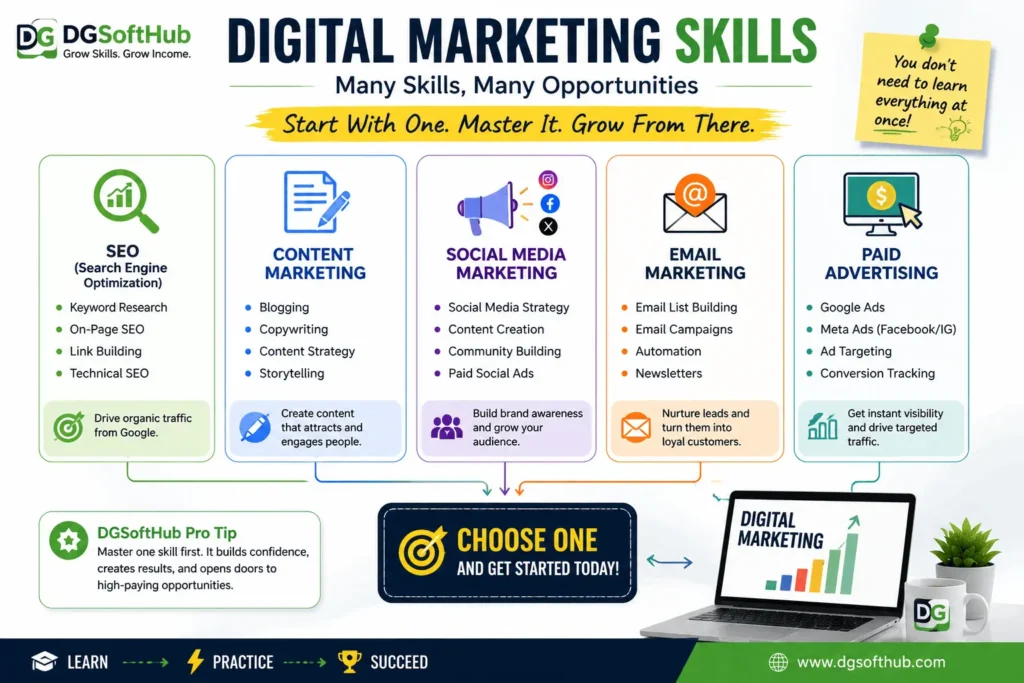
- SEO — how people find things on Google without paying for ads
- Social media marketing — how brands grow audiences on Instagram, LinkedIn, etc.
- Content marketing — blogs, videos, and posts that pull people in organically
- Paid ads — Google Ads and Meta Ads basics (you won’t run them yet, just understand what they are)
You don’t need to master all four. You just need to know what each one is before picking a lane.
Most beginners make the mistake of trying to learn SEO, social media marketing, paid advertising, email marketing, and content writing all at once. In practice, the people who improve fastest usually focus on one skill first, build confidence through practice, and then expand into other areas.
Digital Marketing Skills Comparison for Beginners
If you’re unsure which digital marketing skill to learn first, this comparison can help you choose based on your interests, learning curve, and long-term opportunities.
| Skill | Beginner Friendly | Free to Learn | Freelance Demand | Income Potential | Best For |
|---|---|---|---|---|---|
| SEO | ⭐⭐⭐⭐⭐ | ✅ | ⭐⭐⭐⭐⭐ | ⭐⭐⭐⭐⭐ | Long-term website growth and blogging |
| Content Writing | ⭐⭐⭐⭐⭐ | ✅ | ⭐⭐⭐⭐⭐ | ⭐⭐⭐⭐☆ | Blogs, websites, and copywriting |
| Social Media Marketing | ⭐⭐⭐⭐☆ | ✅ | ⭐⭐⭐⭐☆ | ⭐⭐⭐⭐☆ | Content creators and small businesses |
| Email Marketing | ⭐⭐⭐☆☆ | ✅ | ⭐⭐⭐⭐☆ | ⭐⭐⭐⭐☆ | Customer retention and automation |
| Google Ads | ⭐⭐⭐☆☆ | ✅ | ⭐⭐⭐⭐⭐ | ⭐⭐⭐⭐⭐ | Paid advertising campaigns |
| Graphic Design (Canva) | ⭐⭐⭐⭐☆ | ✅ | ⭐⭐⭐⭐☆ | ⭐⭐⭐⭐☆ | Social media and marketing creatives |
Step 2: Pick One Skill and Ignore the Rest (For Now)
This is where things usually go wrong. People try to learn SEO, social media, email marketing, and copywriting all in the same month — and end up mediocre at four things instead of good at one.
Pick one. I usually tell beginners to start with either SEO or content writing, because both skills stack well into everything else later. Social media is great too, but it’s more saturated and moves faster, which makes it harder for a total beginner to keep pace.
Whatever you pick, give it 60 days of focused attention before you even consider switching.
Step 3: Use Free Platforms That Actually Teach, Not Just Talk
Not every free YouTube video is good. Some are outdated, some are just ad-reads with no real substance. Look for channels and blogs that show their actual work — screen recordings, real campaigns, real numbers.
A few categories worth exploring:
- YouTube tutorials from creators who show live examples, not just slides
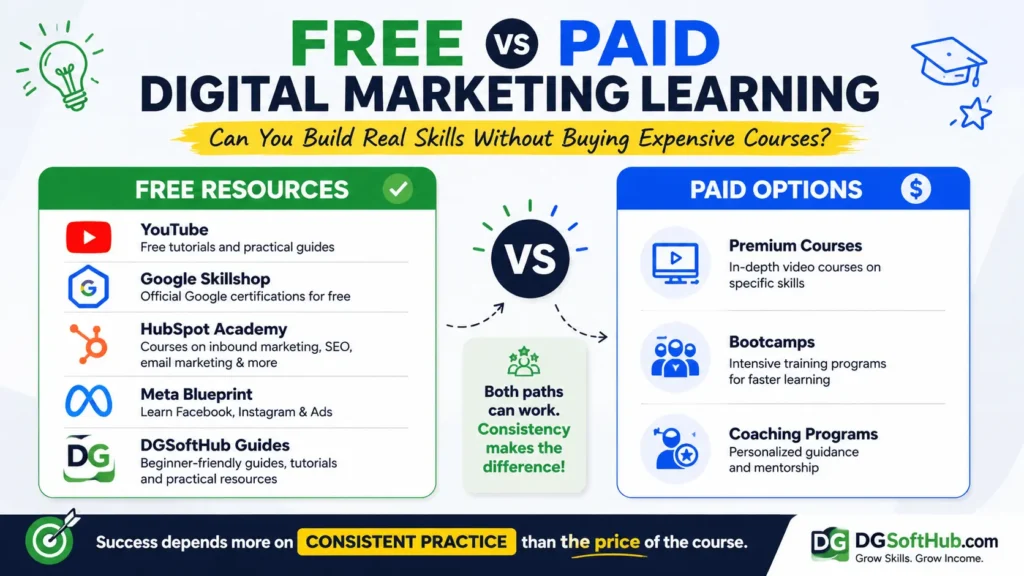
- Official free resources — Google’s Skillshop, HubSpot Academy, Meta Blueprint all offer free certifications
- Niche blogs written by working freelancers (like this one) that walk through real scenarios instead of textbook theory
Step 4: Practice on Something Real — Even If It’s Small
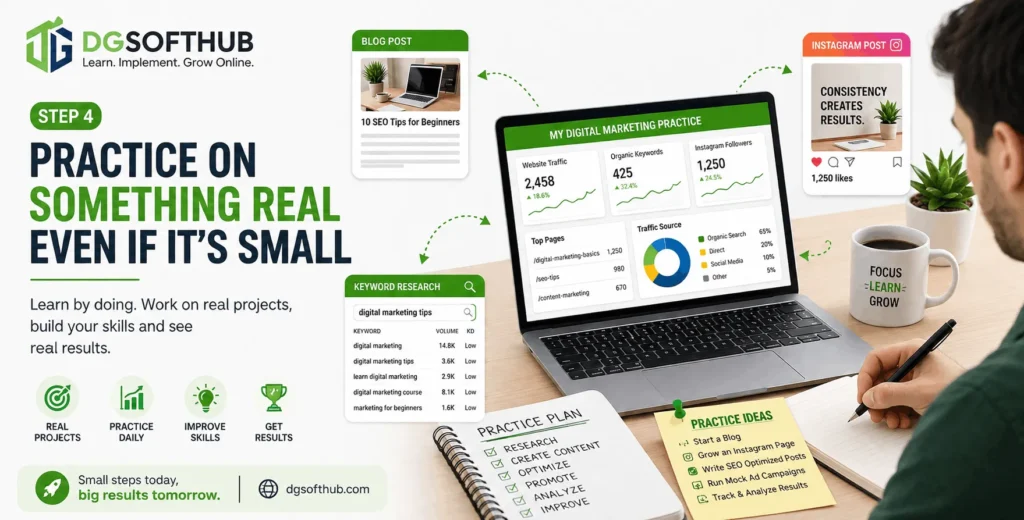
Learning without practicing is basically just collecting information you’ll forget in three weeks. In practice, what this looks like is picking a small, low-stakes project and treating it like a real client job.
Imagine this: you’re learning SEO. Instead of just watching videos, you start a free blog on a niche you actually care about — food, fitness, gadgets, whatever — and try to rank one post for a low-competition keyword. That one exercise will teach you more than ten hours of passive video watching.
Other practice ideas:
- Start a small Instagram page and grow it from zero using only organic content
- Write three blog posts a week, even if nobody reads them yet
- Run a mock ad campaign in Meta’s Ads Manager using play money (the platform lets you set up campaigns without spending)
Step 5: Get Comfortable With Free Tools Early
You don’t need paid software to look professional. Here’s what covers 90% of a beginner’s needs:
- Canva for graphics, social posts, and basic design work — the free plan is genuinely enough for months
- Google Analytics & Search Console for understanding traffic and search performance
- Google Trends for spotting what people are actually searching for
- ChatGPT or Claude for brainstorming content ideas, outlining posts, or speeding up research (not for replacing your own thinking — just supporting it)
Best Free Digital Marketing Tools for Beginners
You don’t need expensive software when you’re starting out. These free tools cover almost everything a beginner needs to learn and practice digital marketing.
| Tool | Purpose | Free Version | Best For Beginners? |
|---|---|---|---|
| Canva | Graphics and social media designs | ✅ | ⭐⭐⭐⭐⭐ |
| Google Analytics | Website traffic analysis | ✅ | ⭐⭐⭐⭐⭐ |
| Google Search Console | SEO performance tracking | ✅ | ⭐⭐⭐⭐⭐ |
| Google Trends | Keyword and trend research | ✅ | ⭐⭐⭐⭐☆ |
| ChatGPT | Brainstorming and content ideas | ✅ | ⭐⭐⭐⭐☆ |
| Google Keyword Planner | Keyword research | ✅ | ⭐⭐⭐⭐☆ |
| Ubersuggest | SEO keyword ideas | Limited Free | ⭐⭐⭐⭐☆ |
| Meta Business Suite | Facebook & Instagram management | ✅ | ⭐⭐⭐⭐☆ |
Learning a tool isn’t the goal—using it to solve real problems is. Whether you’re researching keywords, designing graphics, or checking website performance, practical experience is what turns knowledge into a useful skill.
Here’s where things usually go wrong: many beginners keep collecting courses and tools without ever applying what they’ve learned. Before you move on, keep this advice in mind.
💡 DGSoftHub Pro Tip
One mistake we see repeatedly is beginners spending months collecting free courses instead of finishing one learning path. Digital marketing isn’t about watching the most videos—it’s about applying what you learn. Complete one practical project, then build on it. Consistent practice will always outperform endless research.
Struggling to set up your first project? Click here to download our Free Starter Kit with ready-made templates and client outreach scripts to fast-track your 90-day roadmap.
Step 6: Build a Visible Online Presence
Clients and employers can’t hire what they can’t see. This is important because your “proof of work” matters more in this field than your resume does.
At minimum, aim for:
- A simple Fiverr or Upwork profile showcasing 2–3 sample projects
- A basic personal blog or portfolio site (even a free WordPress.com or Notion page works to start)
- One active social platform where you post consistently, even if the following is small
One thing becomes clear once you start building projects: employers and clients are usually more interested in seeing what you can do than reading a long list of completed courses. Even a small portfolio built from personal projects can demonstrate initiative and practical ability.
Step 7: Start Applying What You’ve Learned
Once you’ve got a small portfolio and a working understanding of your chosen skill, start applying it — for real, even if it’s unpaid or low-paid at first.
- Offer to help a local small business with their social media for free, in exchange for a testimonial
- Take on your first freelance gig, even if it’s underpriced
- Start monetizing your own blog through affiliate links or Google AdSense once you have consistent traffic
This is the part nobody talks about: your first few “clients” are really just extended practice with slightly higher stakes. Treat them that way and you’ll learn faster than people who wait until they feel “ready.”
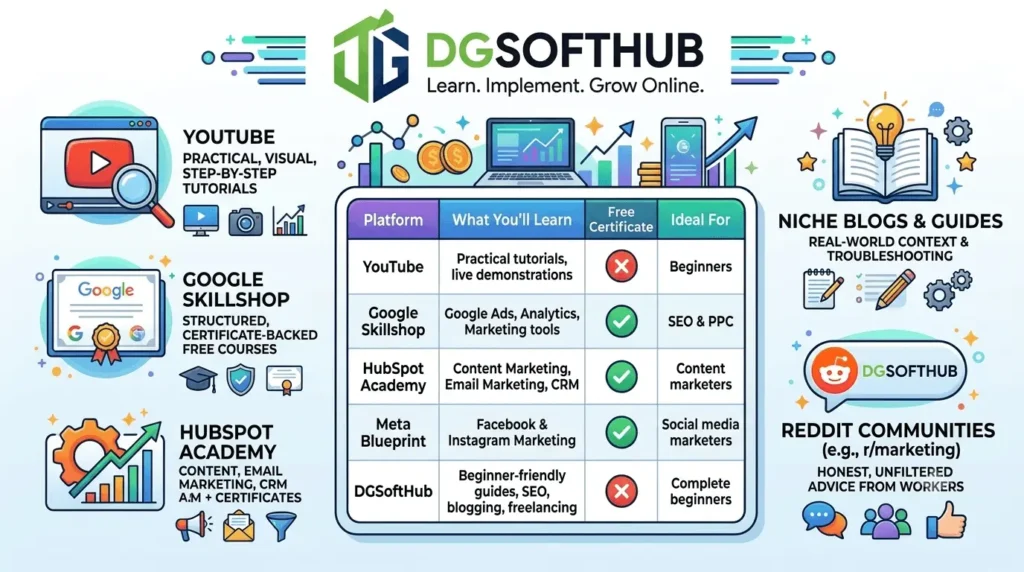
Best Free Platforms to Learn Digital Marketing
- YouTube — for practical, visual, step-by-step tutorials
- Google Skillshop & HubSpot Academy — for structured, certificate-backed free courses
- Niche blogs and guides — for real-world context and troubleshooting
- Reddit communities (like r/marketing or r/SEO) — for honest, unfiltered advice from people actually doing the work
| Platform | What You’ll Learn | Free Certificate | Ideal For |
|---|---|---|---|
| YouTube | Practical tutorials and live demonstrations | ❌ | Beginners |
| Google Skillshop | Google Ads, Analytics, and Marketing tools | ✅ | SEO & PPC |
| HubSpot Academy | Content Marketing, Email Marketing, CRM | ✅ | Content marketers |
| Meta Blueprint | Facebook & Instagram Marketing | ✅ | Social media marketers |
| DGSoftHub | Beginner-friendly guides, SEO, blogging, freelancing | ❌ | Complete beginners |
Common Mistakes Beginners Make
- Trying to learn everything at once. This spreads your attention so thin that you retain almost nothing well.
- Consuming content without creating anything. Watching 50 SEO videos doesn’t teach you SEO. Writing and ranking one post does.
- Giving up around week three. This is almost always when results feel invisible — right before things start clicking. Push past it.
- Comparing your Day 10 to someone else’s Year 3. I’ve seen beginners quit over this constantly. It’s not a fair comparison and it never will be.
How Long Does It Actually Take?
Realistically, here’s a timeline based on consistent daily effort (1–2 hours a day):
- Weeks 1–4: Fundamentals and picking your lane
- Weeks 4–12: Skill-building and hands-on practice
- Months 3–6: First freelance gigs or monetized content
- Months 6+: Steady, repeatable income if you stayed consistent
Progress rarely follows a straight line. Some concepts click immediately, while others take repeated practice. That’s completely normal. The important part is maintaining a steady learning routine instead of expecting instant results.
Consistency beats speed here, every time. Someone who studies 45 minutes daily for six months will outperform someone who binges for a weekend and disappears.
Realistic Digital Marketing Learning Timeline
Everyone learns at a different pace, but most beginners follow a similar progression when they stay consistent.
| Time Period | Primary Focus | Expected Outcome |
|---|---|---|
| Week 1 | Learn the fundamentals | Understand major digital marketing areas |
| Weeks 2–4 | Choose one skill and practice daily | Build confidence with the basics |
| Month 2 | Create portfolio projects | Develop practical experience |
| Months 3–4 | Start freelancing or internships | Land your first real projects |
| Months 5–6 | Improve skills and specialize | Build steady income opportunities |
90-Day Digital Marketing Learning Roadmap
Learning digital marketing doesn’t happen overnight, but it also doesn’t have to take years. If you dedicate 1–2 hours a day, this roadmap provides a realistic path from complete beginner to someone ready to build a portfolio and pursue freelance opportunities.
Month 1: Build a Strong Foundation
Goal: Understand the basics and choose one skill to focus on.
✅ Learn what SEO, content marketing, social media marketing, email marketing, and paid advertising actually do.
✅ Choose one skill to learn first.
✅ Create a study schedule you can realistically follow.
✅ Open free accounts for Google Analytics, Google Search Console, Canva, and ChatGPT.
✅ Watch beginner tutorials and take notes instead of just watching passively.
Milestone: You understand the digital marketing landscape and have committed to one learning path.
This is where many learners lose momentum. They spend weeks comparing courses instead of completing one. A small project completed today teaches far more than another ten hours of research.
Month 2: Practice What You’re Learning
Goal: Turn knowledge into practical experience.
✅ Start a small blog, website, or social media page.
✅ Publish your first content consistently.
✅ Practice keyword research.
✅ Create graphics using Canva.
✅ Learn to use free SEO and analytics tools.
✅ Build 2–3 portfolio samples.
Milestone: You have practical work that demonstrates your growing skills.
Ready to Turn Free Learning Into a Real Plan?
You can learn a lot of digital marketing for free. The challenge is knowing what to learn first, what to practice, and how to move from scattered resources to a structured learning path.
Digital Marketing for Beginners — Complete 2026 Roadmap gives you that structure, with practical guidance, exercises, worksheets, and a 90-day action plan.
Your purchase includes:
- 📘Digital Marketing for Beginners — Complete 2026 Roadmap
A practical beginner-friendly guide with exercises, worksheets, and a 90-day action plan. - 🧰SEO Success Toolkit — 2026
An 8-module implementation workbook for turning SEO knowledge into a repeatable workflow. - 🔎Google Search Console Action Checklist — 2026 Edition
A practical checklist for monitoring and improving your site’s search performance.
One purchase. Three practical resources.
$19 — Instant digital access
Learn. Implement. Grow Online.
Month 3: Build Experience and Start Earning
Goal: Gain confidence through real projects.
✅ Create a Fiverr or Upwork profile.
✅ Apply for beginner-friendly freelance projects.
✅ Offer your services to local businesses or friends.
✅ Collect testimonials and improve your portfolio.
✅ Continue learning while working on real projects.
Milestone: You’re ready to pursue freelance work, internships, or monetize your own projects.
By this stage, you don’t need to know everything. The goal is to build enough practical knowledge that you feel comfortable applying your skills in real situations. Use the checklist below to measure progress, not perfection.
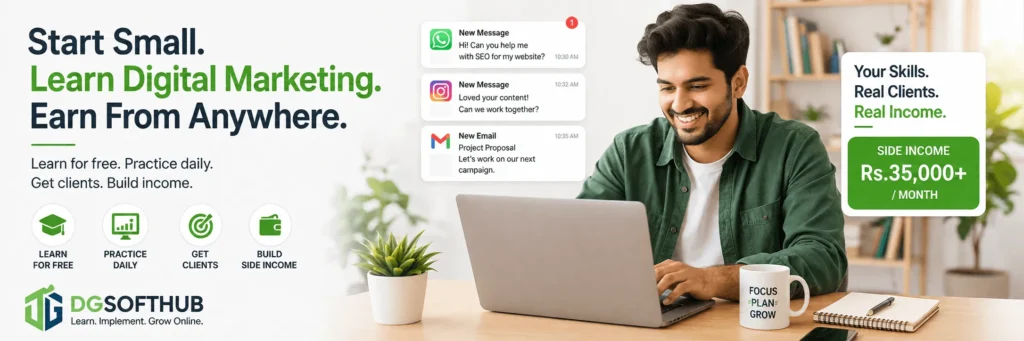
Building practical digital marketing skills can lead to your first freelance clients and a reliable side income from home.
Beginner’s Digital Marketing Success Checklist
You’ve covered the fundamentals, explored the essential skills, and seen a practical roadmap for getting started. Before you move on, use this checklist to see how far you’ve come and identify any gaps in your learning. You don’t need every box checked today—treat it as a simple guide to keep your progress on track.
Learning Fundamentals
- ☐ I understand the main areas of digital marketing.
- ☐ I’ve chosen one skill to focus on first.
- ☐ I follow a consistent weekly learning schedule.
Practical Experience
- ☐ I’ve completed at least one personal project.
- ☐ I’ve written blog posts, created social content, or optimized a webpage.
- ☐ I’ve built 2–3 portfolio samples.
Essential Tools
- ☐ I know how to use Canva.
- ☐ I’ve explored Google Search Console.
- ☐ I’ve used Google Analytics.
- ☐ I’ve researched keywords using free tools.
- ☐ I’ve used AI tools responsibly to support my work.
Professional Presence
- ☐ I’ve created a LinkedIn profile.
- ☐ I’ve built a basic portfolio or personal website.
- ☐ I’ve created a Fiverr or Upwork profile.
Ready to Earn
- ☐ I’m confident explaining my chosen skill.
- ☐ I’ve started applying for freelance projects or internships.
- ☐ I’m actively improving based on feedback.
- ☐ I’m learning consistently instead of waiting to feel “ready.”
Related Guides
If you’re just getting started, these will help fill in the gaps:
- What is Digital Marketing in 2026?
- How to Start Digital Marketing with Zero Investment
- How to Get Your First Client on Fiverr as a Beginner
- Best SEO Tools for Beginners in 2026 (Free & Easy to Use)
- Google Search Console: The Ultimate Practical Guide for Beginners & Growing Websites (2026)
- How to Find Low Competition Keywords (Even If You’re Starting From Zero)
- How to Start Digital Marketing with Zero Investment
- Best Digital Marketing Skills to Learn in 2026
Want a Faster Start?
If you want ready-made templates, client messages, and a clear roadmap:
👉 Download the Digital Marketing Starter Kit and start your journey today
Frequently Asked Questions
Q: Can I really learn digital marketing at home for free, or will I hit a wall eventually?
You can get genuinely competent using free resources alone. The “wall” people hit is usually motivation, not access — the free information out there is more than enough to get you freelancing or job-ready.
Q: Is digital marketing hard to learn for a complete beginner?
Not hard, but it does require consistency. The concepts themselves aren’t complicated — the challenge is sticking with practice long enough to get good.
Q: Can I learn digital marketing from my phone only?
You can start there — watching tutorials, reading guides, even managing basic social pages. But for real practice (website building, ad campaigns, analytics), you’ll eventually want a laptop.
Q: Which digital marketing skill is best for beginners to start with?
SEO and content writing tend to be the most beginner-friendly, since they don’t require a budget and the skills stack well into everything else you’ll learn later.
Q: How do I get my first client with no experience?
Start with free or heavily discounted work for a local business or someone in your network, in exchange for a testimonial and a case study you can show future clients.
Q: Do I need certifications to get hired in digital marketing?
No, but free certifications (like Google Skillshop or HubSpot Academy) don’t hurt and can make your profile look more credible to clients who don’t know you yet.
Q: How much money can I realistically make starting from zero?
It varies a lot, but many beginners land their first Rs.5,000–Rs.15,000 project within 3–6 months of consistent practice and portfolio-building.
The biggest difference between beginners who eventually succeed and those who quit usually isn’t talent—it’s consistency. Learning a little each week and applying those lessons to real projects creates momentum that short bursts of motivation rarely achieve.
Take Action on Your Digital Marketing
Get all 3 practical resources for $19.
What You Should Do Next
Stop researching and start doing — that’s genuinely the biggest lever here. Specifically:
- Pick one skill today — SEO, content writing, or social media. Write it down somewhere you’ll see it daily.
- Block 1 hour tomorrow morning to watch one solid tutorial and take actual notes, not just passive watching.
- Start a small practice project this week — a blog, an Instagram page, or a mock ad campaign. Something with your name on it.
- Set a 60-day check-in on your calendar to review your progress and decide whether to go deeper or pivot skills.
- Grab the free Starter Kit above if you want templates and outreach scripts instead of building everything from scratch.
Every guide published on DGSoftHub is designed with one goal in mind: helping beginners avoid common mistakes, build practical skills, and make steady progress through clear, actionable advice rather than unnecessary complexity.
About the Author
This guide was created by Muhammad Arif Hussain, founder of DGSoftHub and our editorial team. at DGSoftHub, we focus on practical, no-fluff digital marketing resources for beginners and freelancers building an online income from home. Everything here comes from real trial-and-error — not recycled theory — because we’d rather you skip the mistakes we already made.
DGSoftHub — helping beginners learn digital marketing, freelancing, and online income skills, one honest guide at a time.
[…] how to learn at home free […]
[…] How to Start Digital Marketing […]
[…] How to start Digital Marketing […]
[…] How to Learn Digital Marketing at Home for Free […]