
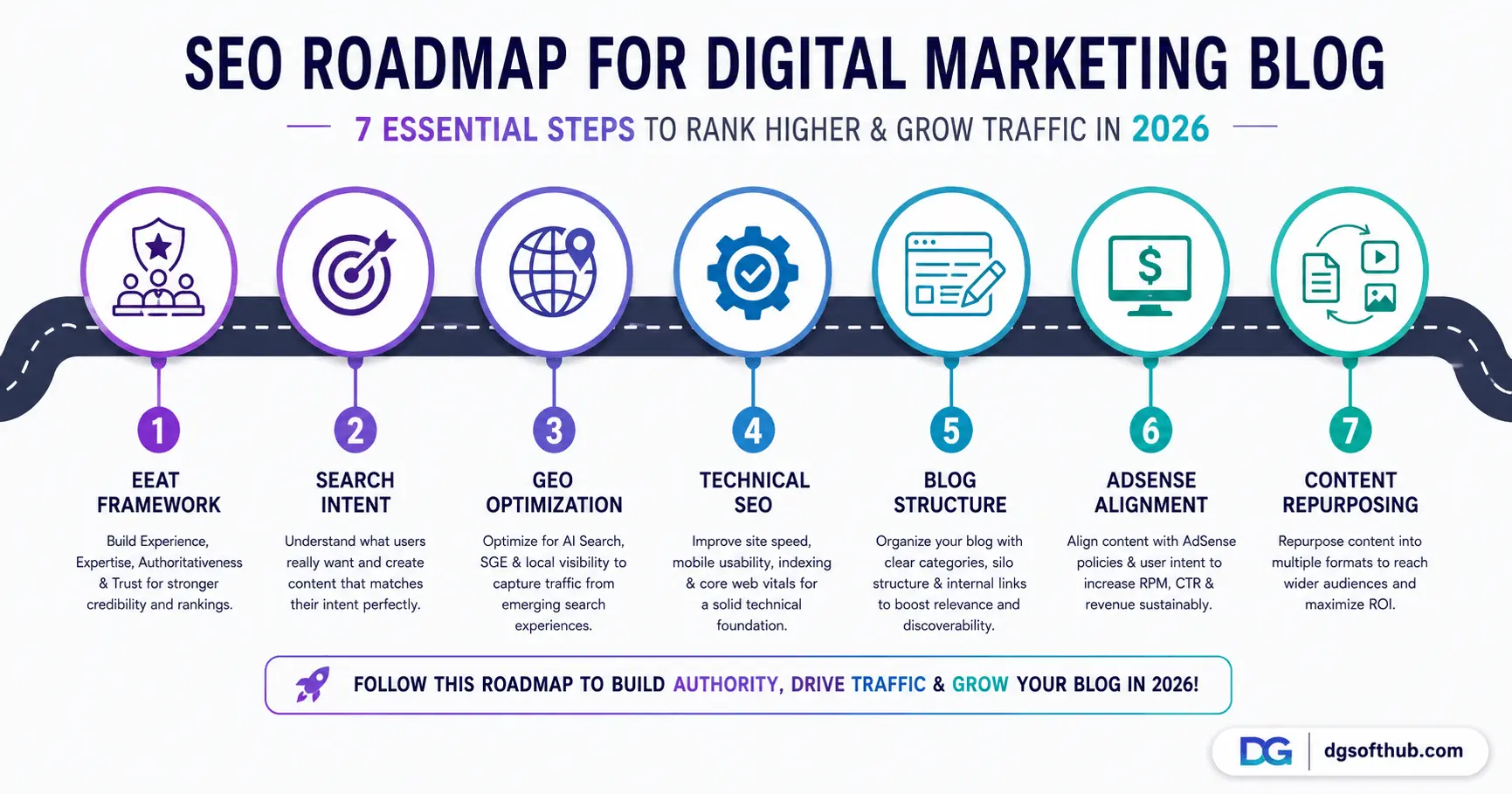
The Ultimate 2026 Roadmap: How to SEO Your Digital Marketing Blog
INTRODUCTION
Most beginners who start a digital marketing blog make the same mistake. They write a few posts, stuff in some keywords, wait three months, and wonder why nothing is ranking.
Here’s the honest answer: SEO in 2026 is not what it was in 2020. The rules have shifted. Google is smarter. And the blogs that are actually growing traffic right now are doing things differently.
This roadmap breaks down exactly what works today — not theory, but a practical step-by-step approach built around how search engines actually evaluate content in 2026. Whether you’ve just started your blog or you’ve been at it for a while without results, this guide gives you a clear path forward.
When I started focusing on SEO for DGSoftHub, I spent far too much time worrying about publishing frequency and not enough time understanding search intent and site performance. Looking back, fixing those two areas produced more results than publishing dozens of extra articles.
WHY MOST DIGITAL MARKETING BLOGS STRUGGLE TO RANK
Before jumping into tactics, it’s worth understanding why so many blogs fail to gain traction — even when the writer clearly knows their subject.
The most common reasons:
- Publishing content without researching search intent first
- Writing for search engines instead of actual readers
- Ignoring technical issues like page speed and mobile experience
- Treating SEO as a one-time task instead of an ongoing process
- Producing thin content that covers a topic at surface level only
A mistake I see often is assuming that publishing consistently is enough. It isn’t. Fifty average posts will almost always underperform ten genuinely useful ones. Quality wins — and in 2026, Google’s systems are good enough to tell the difference.
⚠️ Biggest Mistake
Many new bloggers focus on publishing more content when the real problem is that the content doesn’t match search intent. Ten useful articles will usually outperform fifty average ones.
1- BUILD YOUR CONTENT AROUND EEAT — NOT JUST KEYWORDS
What EEAT Actually Means for Bloggers
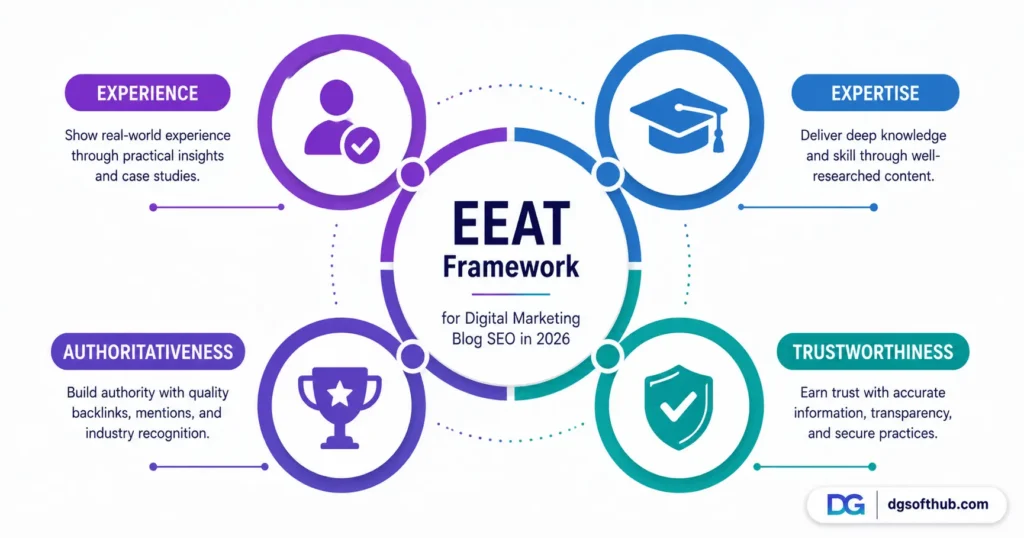
Google’s EEAT framework stands for Experience, Expertise, Authoritativeness, and Trustworthiness. It sounds technical but the practical meaning is simple: Google wants to see that real people with real knowledge are behind the content.
For a digital marketing blog, this means:
Experience — Share what you’ve actually tried. Did a particular SEO tactic work for your site? Did it fail? Real outcomes matter more than textbook explanations.
Expertise — Demonstrate that you understand the topic deeply. This comes through in the level of detail, the nuance in your explanations, and your ability to address the questions readers actually have.
Authoritativeness — Build credibility through consistent publishing, internal linking across related posts, and earning mentions or links from other sites in your niche.
Trustworthiness — Have a clear About page, an author bio, a visible privacy policy, and cite your sources when you reference statistics or research.
A Practical EEAT Checklist for Every Post
Before publishing any article, run through this:
- Does the post include at least one personal example or real observation?
- Are external sources cited where statistics or claims are made?
- Is the author bio visible on the post?
- Does the content answer the reader’s actual question — not just a keyword?
- Is there a clear takeaway or next step at the end?
Something that surprised me early on was how many of my posts read like Wikipedia entries — technically accurate but completely impersonal. That type of content is easy to produce and easy to ignore. Adding even one specific personal observation changes the feel of an article completely. On DGSoftHub I make it a habit to include at least one real outcome in every post — even a small one.
2-UNDERSTAND SEARCH INTENT BEFORE YOU WRITE ANYTHING
This is probably the single most overlooked step in SEO for digital marketing blogs.
Before writing any post, search your target keyword on Google and look at what’s actually ranking. Ask yourself:
- Are the results how-to guides, comparison articles, or listicles?
- Are they short and direct, or long and detailed?
- Are they targeting beginners or experienced marketers?
If Google is consistently ranking 1,500-word beginner guides for your keyword and you write a 4,000-word advanced deep-dive, you’ll likely rank poorly — not because your content is bad, but because the format doesn’t match what Google has decided searchers want.
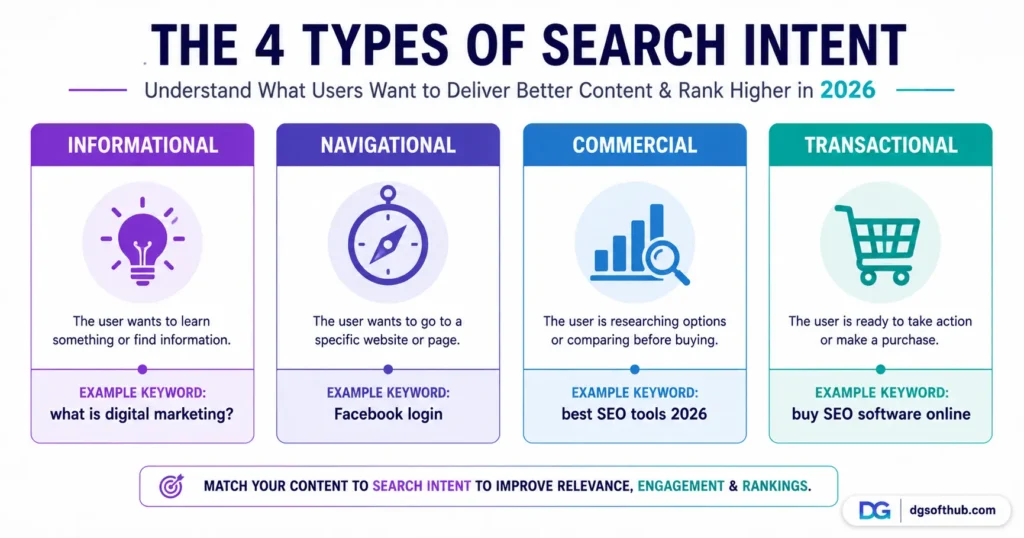
Types of Search Intent to Know
| Intent Type | What the Reader Wants | Example Keyword |
| Informational | Learn something | how to start digital marketing |
| Navigational | Find a specific site | HubSpot blog |
| Commercial | Compare options | best SEO tools for beginners |
| Transactional | Buy or sign up | buy Semrush subscription |
Most digital marketing blog posts target informational or commercial intent. Match your format and depth to what’s already working for that keyword.
3-OPTIMIZE FOR GENERATIVE ENGINE OPTIMIZATION (GEO)
What GEO Means and Why It Matters Now
Traditional SEO got you a blue link in search results. GEO is about getting your content cited inside AI-generated summaries — the answers Google and other AI tools surface before users even click a result.
This is becoming increasingly important. If your blog is the source an AI summarizes, you get visibility even when users don’t visit your site directly. And when they do click through, they already trust you.
How to Optimize Your Blog Posts for GEO
Answer the question in the first paragraph. Place a direct, clear answer to your main topic within the first 50–60 words. Don’t make readers scroll to find the point.
Use structured formatting. Numbered lists, clear H2 and H3 headings, and short paragraph blocks make it easier for AI systems to extract and summarize your content accurately.
Build topical authority. Instead of writing random posts on unrelated subjects, build clusters of interlinked content around a core topic. A pillar post on digital marketing SEO, for example, should link to supporting posts on keyword research, on-page optimization, internal linking, and content strategy.
I started structuring DGSoftHub posts with a direct answer in the first paragraph and a FAQ section at the bottom. Within weeks, one post appeared in a People Also Ask result — something that never happened with my older wall-of-text format.
Use FAQ sections. Questions and direct answers at the end of posts are frequently pulled into AI summaries and People Also Ask results on Google.
4-FIX TECHNICAL SEO — THE PART MOST BLOGGERS SKIP
Content quality matters. But if your site loads slowly, shifts around on mobile, or has broken links, you’re losing rankings regardless of how good your writing is. After fixing image dimensions on my own blog, my CLS score dropped from 0.217 and LCP improved from 2.6s to 2.3s — just from adding width and height attributes to images. No plugins, no code rewrite. On DGSoftHub, converting featured images from JPEG to WebP reduced image size by more than 50% while maintaining visual quality.
Core Web Vitals — What to Actually Focus On
Google uses Core Web Vitals as ranking signals. These are:
LCP (Largest Contentful Paint) — How fast your main content loads. Target: under 2.5 seconds.
CLS (Cumulative Layout Shift) — How much your page shifts while loading. Target: under 0.1. This is commonly caused by images without fixed dimensions.
INP (Interaction to Next Paint) — How quickly your page responds to user input. Target: under 200ms.
To check your scores, use Google PageSpeed Insights. Run both mobile and desktop tests — mobile performance is weighted more heavily for most blogs.
🚀 Quick Win
If you only fix one technical SEO issue this week, improve your page speed. A fast website improves user experience, Core Web Vitals, and AdSense performance at the same time.
Quick Technical Fixes That Make a Real Difference
- Compress all images before uploading (TinyPNG or Squoosh work well)
- Add width and height attributes to every image to prevent layout shift
- Use a caching plugin like WP Rocket or LiteSpeed Cache
- Enable lazy loading on images below the fold
- Use WebP format instead of JPEG or PNG where possible
Many beginners spend months tweaking their content while ignoring a 6-second page load time that’s costing them rankings every day. Fix the technical side first — it removes a ceiling on everything else you do.
5-STRUCTURE YOUR BLOG POSTS FOR BOTH READERS AND SEARCH ENGINES
How to Use Headings Properly
A well-structured post helps readers scan and find what they need. It also helps Google understand what each section covers.
Use one H1 per post — your main title. Use H2 headings for major sections. Use H3 headings for subsections within those. Don’t skip levels or use headings just to make text look bigger.
Internal Linking — The Underrated SEO Signal
Every time you publish a new post, look for opportunities to link to it from older related posts. And link from your new post to relevant existing content.
Internal linking does two things: it distributes authority across your site and keeps readers engaged longer — both of which help your SEO over time.
One common mistake beginners make is treating internal linking as optional. Going back to update older posts with links to newer content is one of the highest-return SEO tasks you can do, and most people skip it entirely.
6-ALIGN YOUR CONTENT STRATEGY WITH ADSENSE GUIDELINES
If monetizing your blog with Google AdSense is a goal, your SEO strategy and AdSense compliance need to work together — not against each other. When I added a proper Table of Contents with anchor links to one of my posts, average time on page noticeably improved. Readers could navigate directly to the section they needed instead of bouncing.
What AdSense Actually Requires
AdSense approves sites that have:
- Original, valuable content that genuinely helps readers
- Clear site navigation and a visible privacy policy
- Sufficient content volume (generally 15–20 quality posts minimum)
- A clean user experience without excessive ads or pop-ups
Poor ad placement is one of the most common reasons approved AdSense accounts see declining revenue. Ads that cover content, slow page load significantly, or cause layout shift hurt both user experience and your Core Web Vitals scores.
Although I haven’t applied for AdSense yet, preparing DGSoftHub for approval has highlighted how closely AdSense requirements align with good SEO practices. Improving site structure, creating essential pages, and focusing on useful content benefits both search visibility and future monetization goals.
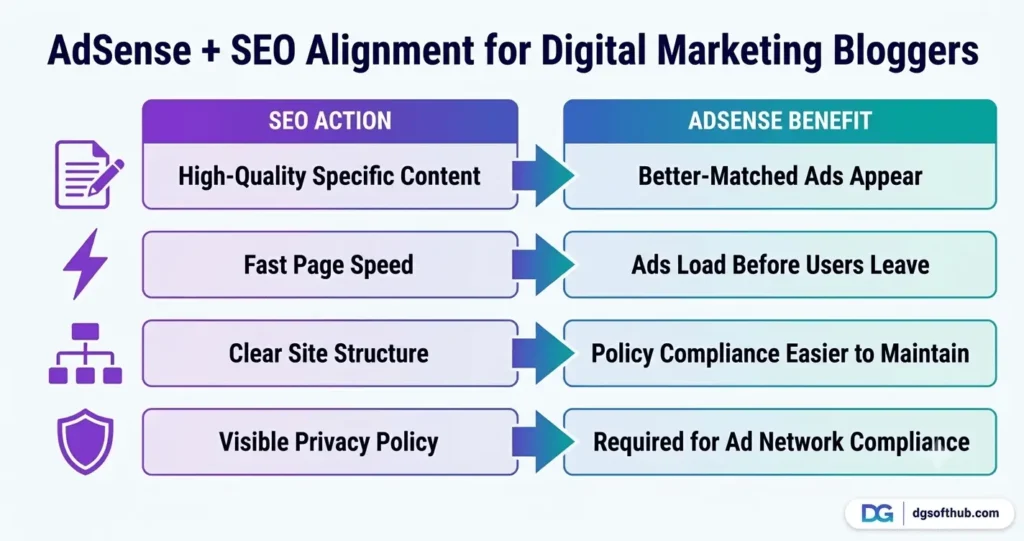
Practical AdSense + SEO Balance
| SEO Action | AdSense Benefit |
| High-quality, specific content | Better-matched ads appear |
| Fast page speed | Ads load before users leave |
| Clear site structure | Policy compliance easier to maintain |
| Visible privacy policy | Required for ad network compliance |
The blogs that perform best with AdSense are the ones that would perform well without it — because the content is genuinely useful and the site experience is clean.
7-REPURPOSE CONTENT TO DRIVE REFERRAL TRAFFIC
A blog post doesn’t have to live only on your blog.
A 1,500-word post on digital marketing SEO tips can become:
- A LinkedIn carousel summarizing the five key points
- A short Instagram Reel walking through one specific tip
- A Twitter/X thread with one idea per tweet
- A Pinterest infographic for visual learners
Repurposing isn’t about copying and pasting. It’s about adapting the core idea for a different format and audience. The referral traffic this generates signals to Google that your content is popular and trusted — which supports your organic rankings over time.
RECOMMENDED SEO WORKFLOW FOR DIGITAL MARKETING BLOGGERS
Here’s a practical workflow you can follow for every post:
| Step | Task | Tool |
| 1 | Research keyword and check search intent | Ubersuggest, Google Search |
| 2 | Check what’s ranking and what format works | Google SERP analysis |
| 3 | Write outline with H2/H3 structure | ChatGPT, Claude, or manual |
| 4 | Write draft with personal insights added | Your own writing |
| 5 | Edit for clarity and readability | Grammarly |
| 6 | Add internal links to related posts | Manual in WordPress |
| 7 | Optimize images — compress, alt text, dimensions | TinyPNG, WordPress |
| 8 | Check page speed before publishing | PageSpeed Insights |
| 9 | Submit URL to Google Search Console | Search Console |
FREQUENTLY ASKED QUESTIONS
How long does it take to rank a digital marketing blog post?
Realistically, 3–6 months for new content on a newer site. Posts targeting low-competition keywords on an established domain can rank faster — sometimes within weeks. The timeline depends on your domain authority, content quality, and how competitive the keyword is.
Do I need to publish every day to rank my digital marketing blog?
No. Publishing frequency matters less than publishing quality. Two genuinely useful, well-optimized posts per month consistently outperform daily thin content. One pattern that shows up repeatedly among beginners is burning out from trying to publish daily — producing worse content as a result.
Does Google AdSense affect my SEO rankings?
AdSense itself doesn’t hurt rankings. Poor ad implementation does. Ads that cause layout shift, slow your page load, or cover content will negatively affect your Core Web Vitals and user experience signals — both of which influence rankings.
What is GEO and why does it matter for digital marketing blogs?
Generative Engine Optimization (GEO) is the practice of optimizing content to be cited in AI-generated search summaries. As AI Overviews become more common in search results, appearing in those summaries gives your blog visibility even before users click a link. I’ve already noticed that posts with clear definitions, numbered steps, and FAQ sections are more likely to be quoted by AI tools than long, opinion-heavy articles are.
How many internal links should I add per post?
There’s no fixed rule. A practical approach is linking to 3–5 relevant existing posts from each new article, and updating older posts to link back to new content whenever relevant. Quality and relevance matter more than volume.
PRACTICAL TAKEAWAY
Pick one section of this roadmap and apply it this week — not all seven steps at once.
If your content isn’t ranking, start with search intent. If your content is ranking but not converting, look at structure and internal linking. If your page speed is poor, fix Core Web Vitals before writing another word.
SEO compounds. Small consistent improvements add up faster than occasional big efforts. The digital marketing blogs that grow steadily in 2026 are the ones built on a foundation of useful content, clean technical setup, and genuine expertise — not shortcuts.
📚 More Guides You May Find Helpful
Download the Digital Marketing Starter Kit and start earning faster
About the Author
Muhammad Arif Hussain is a digital marketer and founder of DGSoftHub — a platform built around practical digital marketing guides, SEO strategies, and online business resources for beginners. With hands-on experience in SEO, content strategy, and freelancing, he writes to help beginners cut through the noise and build real results online. Every guide on DGSoftHub comes from actual testing — not recycled theory. Explore more at dgsofthub.com

[…] The Ultimate 2026 Roadmap: How to Launch Your Digital Marketing Career and Profit […]
[…] The Ultimate 2026 Roadmap: How to SEO Your Digital Marketing Blog […]