
updated in July-2026
Most people don’t fail at making money with digital marketing because the skills are too hard. They fail because they try to learn five things at once and burn out in three weeks. If you’ve been scrolling through “make money online” videos and still don’t know where to actually start, that’s normal — and it’s fixable.
Here’s what this post actually covers: the real ways beginners make money with digital marketing, what you can realistically expect to earn, and the exact starting steps that don’t waste your first six months.
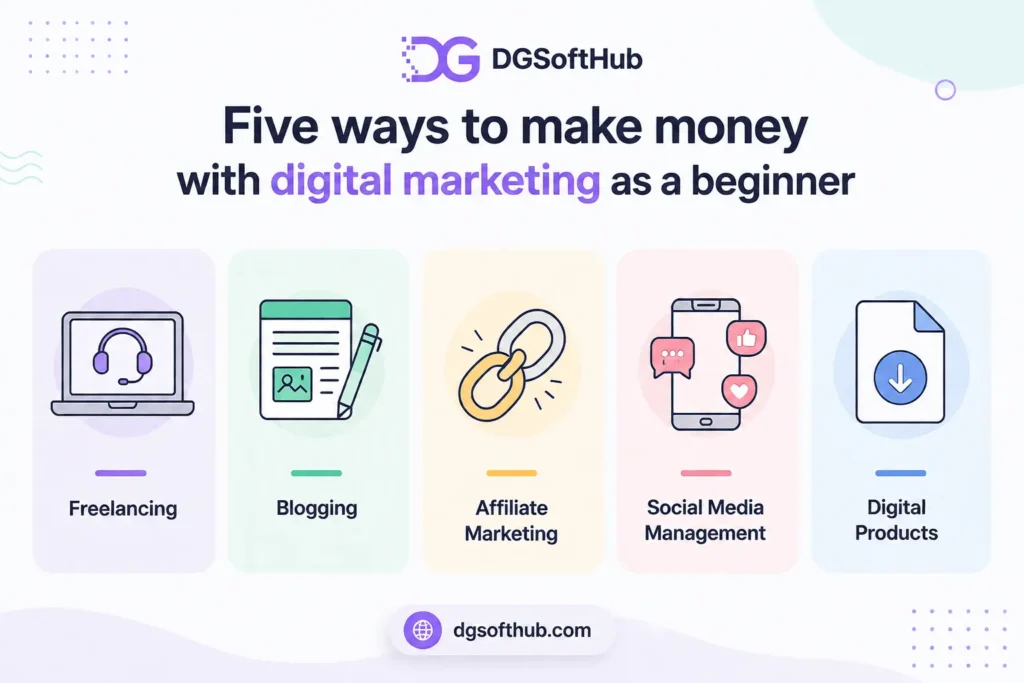
One of the biggest questions beginners ask is, “Where should I start?” The answer depends on what you’re trying to achieve. If your goal is to earn quickly, your path will look different from someone building long-term passive income. Use the table below as a starting point.
| Your Goal | Recommended Path | Why It’s a Good Fit |
| Earn your first income quickly | Freelancing | You can start offering services before building an audience. |
| Build long-term passive income | Blogging | Evergreen content can generate traffic and income for years. |
| Start with minimal investment | Social Media Management | You mainly need a laptop, internet connection, and practical skills. |
| Maximize long-term income | Blogging + Affiliate Marketing | Scales well as your content library and traffic grow. |
| Build a scalable online business | Digital Products | Digital products can be sold repeatedly without increasing delivery costs. |
Each path has its own advantages, and none is universally “best.” Let’s look at what each one involves, who it’s best suited for, and how you can get started.
Can You Actually Make Money With Digital Marketing?
Yes — but not the way most ads make it look. Nobody is making $10,000 in their first month from a laptop on a beach. What actually happens is slower and less dramatic: you pick one skill, get decent at it, find your first client or your first hundred readers, and build from there.
Businesses will always need someone to handle their online presence. That’s not hype, that’s just how the internet works now. Every business with a website needs SEO, content, ads, or social media help — and most small businesses can’t afford to hire a full-time marketing team. That gap is where beginners get their first opportunities.
The honest part nobody says out loud: your first month or two will probably feel unproductive. You’re learning the terminology, figuring out where to find clients, and making mistakes nobody warned you about. That’s not a sign you’re failing. That’s just the beginning of every digital marketing career that eventually works.
The Real Ways People Make Money With Digital Marketing
There isn’t one “best” method — there’s a method that fits your current skills and how much time you actually have. Here’s how each one really works in practice, not just the theory.
Freelancing
This is usually the fastest way to get your first payment, because you’re selling a skill directly instead of waiting for traffic or an audience to build.
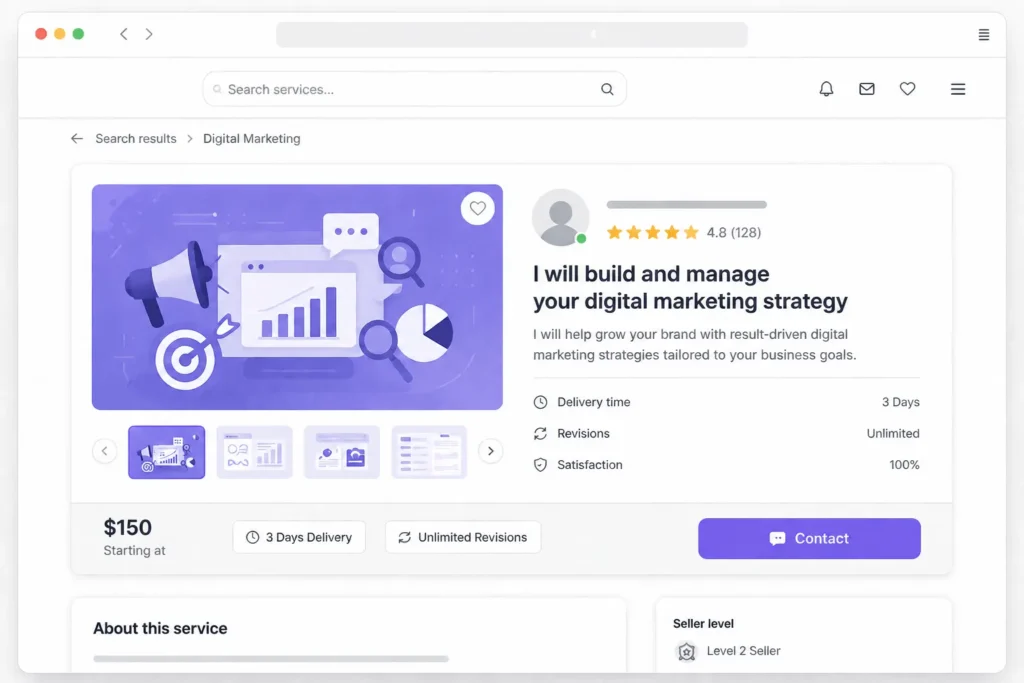
In practice, what this looks like is picking one narrow service — say, on-page SEO audits, or writing product descriptions — and offering it on Fiverr, Upwork, or directly to local businesses. You don’t need five skills. You need one skill and three example projects you can show.
Here’s where things usually go wrong: beginners try to offer “full digital marketing services” instead of one specific thing. Clients don’t trust generalists with no track record. They trust someone who clearly knows one thing well.
Make Money With Blogging
One of the biggest reasons people quit blogging is that progress is almost invisible during the first few months. Then, without much warning, several posts begin attracting traffic at the same time. That’s usually the point where consistent publishing starts turning into measurable results. A well-optimized blog post you publish today can continue bringing in traffic—and potentially generating income—for years with minimal ongoing effort. Very few other online assets work like that.
The trade-off is patience. Most blogs don’t earn meaningful money in the first three to four months. You’re writing, learning basic SEO, and slowly building the kind of content Google trusts enough to rank. Once that trust builds, though, it compounds.
You can monetize a blog through: – Display ads (like Google AdSense) — passive, but you generally need real traffic before it pays meaningfully. – Affiliate links — recommending tools or products you’d genuinely suggest anyway. – Your own digital products — templates, guides, or mini-courses tied to what your blog already teaches.
Affiliate Marketing
This is the “recommend it, earn a commission” model, and it’s popular for a reason — you don’t need to build or ship a product yourself.
Let’s say you publish a review comparing two email marketing tools you’ve actually tested. Months later, someone searching for that comparison lands on your article, clicks your recommendation, and signs up. That’s how affiliate income usually happens—not through viral posts, but through useful content that keeps getting found in search.
The catch: affiliate income depends entirely on trust and traffic. If nobody’s reading your content, there’s nobody to click the link. This method usually pairs best with blogging or an established social following — it’s rarely a fast, standalone starting point.
Social Media Management
Small businesses often know they should be posting consistently, but don’t have the time or the eye for it. That’s the entire opportunity here.
You’re not becoming a “social media guru.” You’re offering something specific: a content calendar, consistent posting, and basic engagement — usually for a monthly retainer. It’s one of the more predictable income streams on this list because it’s recurring, not project-based.
Make Money by Selling Digital Products
Once you understand a topic well enough to teach it, you can package that knowledge — an ebook, a Notion template, a short course — and sell it repeatedly without rebuilding it each time.
This is the method with the Digital products usually become worthwhile only after you’ve answered the same beginner question dozens of times. When you notice yourself repeating the same explanation, that’s often a sign it could become an ebook, checklist, or template. After that, every sale is close to pure profit, minus whatever you spend on hosting or a payment platform.
What You Can Realistically Expect to Earn
I’ll be blunt here, because most “make money online” content won’t be: your first month is probably closer to $0 than $500. That’s not pessimism, that’s the median experience.
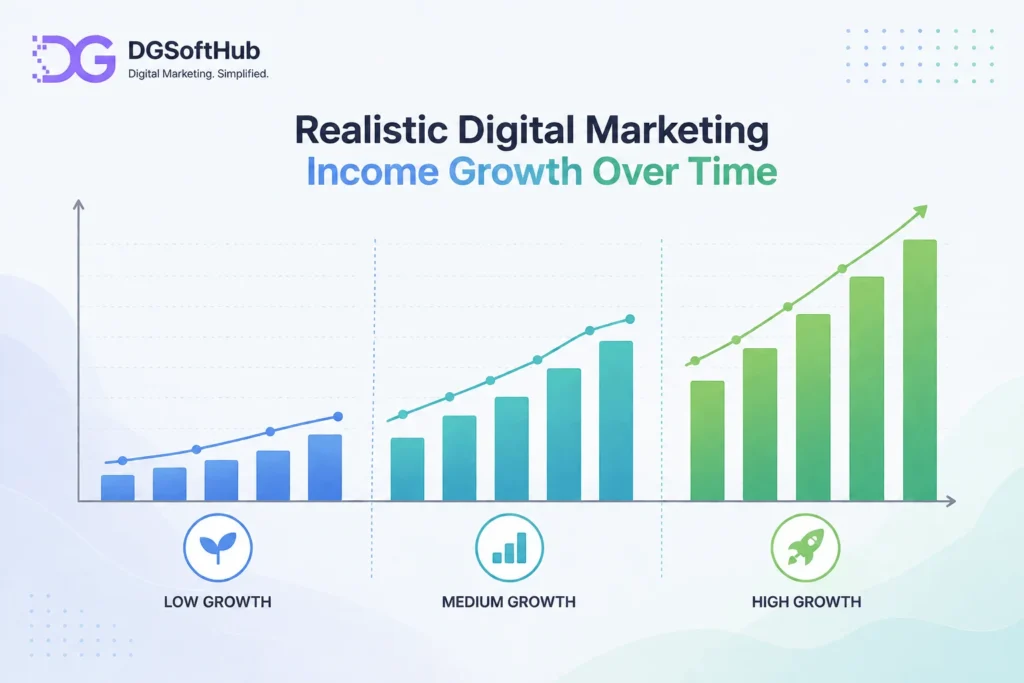
A rough, honest range based on effort and consistency:
- Beginners (first 1–3 months): $50–$200/month, often from one or two small freelance gigs.
- Intermediate (consistent 6+ months in): $300–$1,000/month, usually once you have repeat clients or early blog/affiliate traction.
- Advanced (1+ year, consistent): $1,000+ and often much higher, once you’ve built a portfolio, an audience, or recurring retainer clients.
Consistency moves these numbers far more than talent does. I’ve seen mediocre writers outearn talented ones simply because they showed up every week for a year instead of writing brilliantly for a month and quitting.
How to Actually Start (Without Wasting Six Months)
Most beginners skip this step entirely: picking one thing before touching anything else. Here’s a sequence that actually works instead of just sounding productive.
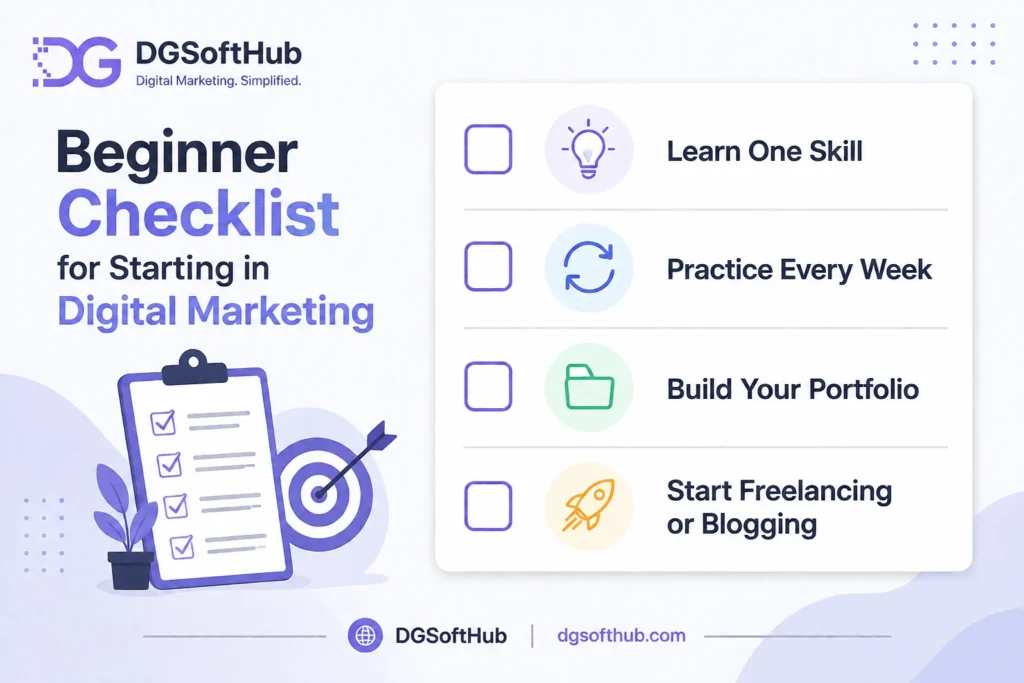
- Choose one skill — SEO, content writing, or social media management are the easiest entry points with the lowest cost to start.
- Practice on a real (even small) project — your own blog, a friend’s business, or a free trial gig counts. Portfolios beat certificates every time.
- Build a simple portfolio — three examples is enough to start pitching clients. You don’t need twenty.
- Start freelancing or publish consistently — pick your lane and show up weekly, not sporadically.
That’s the whole starting sequence. It’s not exciting, but it’s the version that actually produces income instead of just information.
Mistakes That Quietly Kill Beginner Progress
Most people don’t fail because digital marketing is too complicated. They fail in a few very specific, very fixable ways:
- Trying to learn everything at once. SEO, ads, email marketing, and content all at the same time usually means mastering none of them. One thing I’ve noticed while answering beginner questions on DGSoftHub is that people almost always overestimate how many skills they need before earning their first dollar. In practice, becoming really good at one service usually takes you much further than being average at five.
- Not practicing on real work. Watching tutorials feels productive. It isn’t, until you apply it somewhere real. From what I’ve seen on DGSoftHub, the biggest improvements usually happen after someone builds their first website, optimizes their first blog post, or runs their first campaign—not after watching another ten videos.
- Giving up in month two. This is probably the most common mistake I’ve seen. The first few months often feel frustrating because you’re putting in the work without seeing much return. Then, almost without warning, a client replies, a blog post starts ranking, or your first affiliate commission arrives. Most legitimate online income methods take time to build momentum. If you quit during that quiet phase, you’ll never know how close you were to seeing results.
If you only fix one thing after reading this, fix the “learning everything at once” habit. It’s the single biggest reason beginners quit before they see results.
What You Should Do Next
Skip the motivational speech — here’s the actual next step, depending on where you’re starting:
- If you have zero experience: Pick freelancing. Create one Fiverr or Upwork gig around a single, specific service this week.
- If you enjoy writing: Start a blog around one narrow topic you already understand better than most people. Don’t wait for “the perfect niche.”
- If you already have a small following: Look into affiliate marketing with tools or products you’d recommend regardless of commission.
- If you want recurring income sooner: Pitch two local businesses on basic social media management this month — most have never been asked directly.
Whichever path you pick, give it a real three-month runway before judging whether it’s “working.” Almost nothing here pays off in week one.
If you’re still unsure where to begin, don’t try to learn every digital marketing skill at once. Start with one path, follow it consistently, and build from there.
Continue with:
- How to Start a Blog and Make Money
- SEO Basics for Beginners
- How to Find Low Competition Keywords
- The Ultimate 2026 Roadmap: How to Launch Your Digital Marketing Career and Profit
- Rank Your Blog on Google Faster in 2026 (On-Page SEO Checklist for Beginners)
- Best SEO Tools for Beginners in 2026 (Free & Easy to Use)
- Google Search Console: The Ultimate Practical Guide for Beginners & Growing Websites (2026)
Want a Faster Start?
If you want ready-made templates, client messages, and a clear roadmap:
👉 Download the Digital Marketing Starter Kit and start earning faster
Frequently Asked Questions
Can beginners really make money with digital marketing?
Yes. Most people start with one skill — often freelancing or blogging — and grow from there. The income is rarely instant, but it’s realistic with consistent effort.
Which method is best for a total beginner?
Freelancing tends to produce the fastest first payment, since you’re selling a skill directly rather than waiting on traffic or an audience.
How long does it take to start earning?
Freelancing can bring in your first payment within a few weeks. Blogging and affiliate marketing usually take three to six months before earnings feel meaningful.
Do I need to invest money to start?
No. Freelancing and social media management can start with zero investment. Blogging has small costs (hosting, a domain), and digital products cost only your time to create.
Can I do this part-time alongside a job?
Yes, and most people do exactly that at first. Freelancing and blogging both fit around a few hours a week before eventually scaling up.
What’s the biggest mistake beginners make?
Trying to learn every digital marketing skill simultaneously instead of getting genuinely good at one thing first.
Is digital marketing still worth learning in 2026?
Yes. Businesses’ need for online visibility hasn’t slowed down — if anything, more small businesses now compete for attention online than five years ago, which keeps demand for these skills steady.
About the Author
This guide was written by the founder of DGSoftHub, a digital marketing education platform built for people starting from zero. The advice here comes from actually testing these income methods — not just summarizing what other sites already say. DGSoftHub focuses on practical, beginner-first guidance across SEO, content strategy, and digital income — no inflated income screenshots, no shortcuts that don’t hold up.
DGSoftHub — Learn. Implement. Grow Online.
[…] How to make money with digital marketing […]
[…] How to Make Money with Digital Marketing […]
[…] How to Make Money with Digital Marketing (Beginner Guide) […]
[…] How to Make Money with Digital Marketing […]
[…] How to Make Money Online […]
[…] How to Make Money with Digital Marketing […]
[…] How to Make Money with Digital Marketing […]