
Updated Aug-2026
Let’s be honest — the novelty of ChatGPT wore off a while ago. Back in late 2022, getting the tool to write a coherent paragraph felt exciting. Today, that’s the bare minimum. The real question isn’t whether to use ChatGPT for digital marketing. It’s whether you’re using it in a way that actually moves the needle.
Most beginners make the same mistake: they treat ChatGPT like a magic content machine. They type “write me a blog post about email marketing,” copy the output, paste it into WordPress, and wonder why their traffic doesn’t grow. The tool isn’t the problem — the approach is.
This guide is for people who want to use ChatGPT the right way. Whether you’re running a one-person freelance operation, managing content for a small brand, or just getting started with digital marketing — you’ll walk away with specific strategies, real prompts, and an honest picture of what the tool can and can’t do.
Since using ChatGPT in my own content workflow, I’ve found that the biggest benefit isn’t writing entire articles. It’s reducing the time spent on research, outlining, brainstorming, and first drafts.
What used to take an hour can often be done in 10–15 minutes. But speed creates a new problem: it’s easy to publish content that sounds polished yet offers nothing original.
That’s exactly where many beginners struggle.
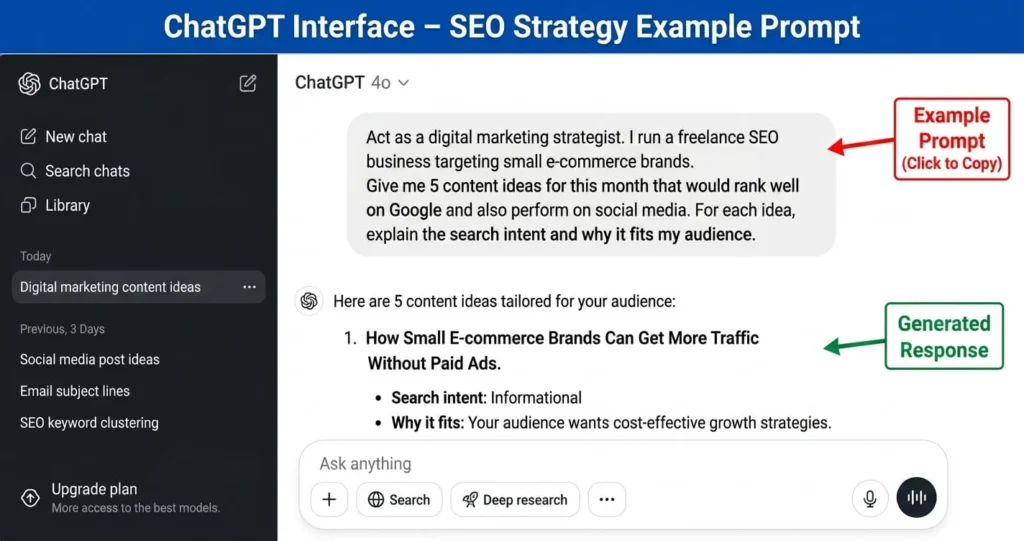
Figure 1: Example
📖 Table of Contents
- 1. Why Most Marketers Misuse ChatGPT
- 2. Setting Up ChatGPT the Right Way
- 3. Using ChatGPT for Content Marketing
- 4. ChatGPT for SEO: Keyword Clusters & Competitor Gaps
- 5. Social Media Content Without the Burnout
- 6. Email Marketing: Hooks That Actually Get Opened
- 7. Paid Ads: Scaling Copy Without Scaling Costs
- 8. My Biggest ChatGPT Marketing Mistake
- 9. The Three Rules Every AI Marketer Should Follow
- 10. Frequently Asked Questions
- 11. Final Takeaway
1-Why Most Marketers Misuse ChatGPT
Here’s something most “AI marketing” guides won’t tell you: ChatGPT is terrible at replacing human judgment. It’s excellent at accelerating it.
Many beginners struggle with this distinction. They expect the tool to think for them — to come up with the strategy, understand the audience, and produce content that connects. That’s not how it works. ChatGPT is pattern-based. It predicts what a reasonable response would look like based on everything it’s been trained on. Which means, without proper guidance, it produces the most average possible version of whatever you ask for.
Average content doesn’t rank. Average emails don’t get opened. Average ads don’t convert.
The marketers getting real results from ChatGPT treat it more like a skilled assistant than an autonomous creator. They bring the strategy, the brand knowledge, and the real-world context. The AI handles the drafting, the variation, and the speed.
2-Setting Up ChatGPT the Right Way
Before you write a single prompt, it’s worth spending an hour building your working environment. This setup work pays dividends across every single task you do afterward.
Choose the Right Plan
The free version of ChatGPT is fine for casual experimentation. But for marketing work, the paid tier (ChatGPT Plus at $20/month) is worth it. You get access to GPT-4o, which produces noticeably better output for complex tasks like brand tone matching, structured content planning, and nuanced audience targeting.
If you’re running an agency or working with a team, ChatGPT Enterprise adds stronger privacy controls and higher usage limits.
Build a Custom GPT for Your Brand
One of the most underused features in ChatGPT is the ability to create Custom GPTs. Think of it as a pre-loaded version of the tool that already knows who you are.
Inside your Custom GPT, you can upload:
- Your brand voice guide (tone, writing style, words to avoid)
- Buyer personas with demographics, pain points, and goals
- 2–3 examples of your best-performing past content
- Your standard blog structure or social caption format
Once that’s done, you stop repeating yourself every session. Every output already fits your brand.
Master the Framing Prompt
The single biggest upgrade most beginners can make is learning how to open a conversation. Instead of diving straight into a task, set the stage:
| Example Framing Prompt “Act as a digital marketing strategist with experience in B2B SaaS. Our target audience is small business owners who are skeptical of automation. Our tone is conversational, direct, and avoids corporate jargon. With that context in mind, help me with the following…” |
That one setup paragraph will improve every output that follows it. Don’t skip it.
3-Using ChatGPT for Content Marketing
Content marketing is where ChatGPT gets misused the most — and where it can also add the most value when used properly.
The Hybrid Approach: AI Structure, Human Depth
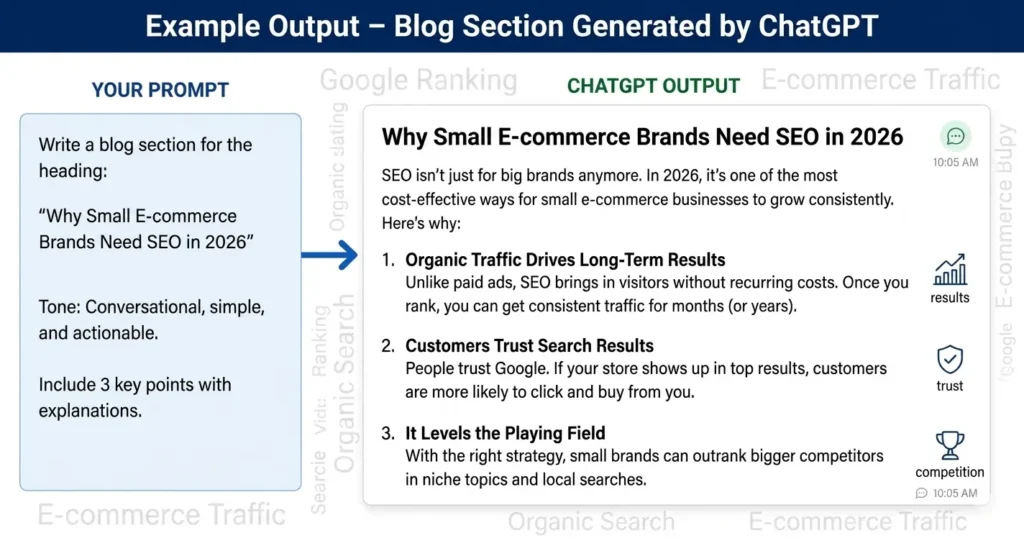
Asking ChatGPT to write a full article from scratch is a fast path to thin, generic content. Search engines are getting much better at detecting this, and readers can feel it too — it reads smoothly but says nothing new.
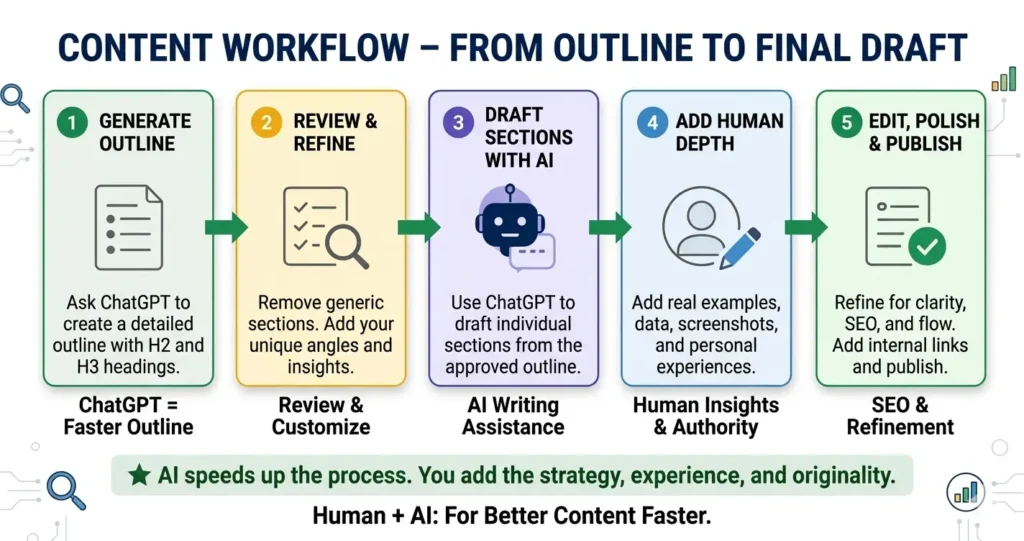
A better approach: use ChatGPT to build the skeleton, then fill in the muscle yourself.
| Step-by-Step Content Process Step 1: Ask ChatGPT to generate an article outline with H2 and H3 headings. Step 2: Review the outline and remove anything generic or already covered everywhere. Step 3: Add sections based on your own experience, data, or unique perspective. Step 4: Use ChatGPT to draft individual sections you’ve approved in the outline. Step 5: Rewrite key paragraphs in your own voice before publishing. |
| Marketing Task | Traditional Workflow | With ChatGPT |
|---|---|---|
| Blog Outline | 30–45 minutes | 5–10 minutes |
| Headline Brainstorming | 20 minutes | 2–5 minutes |
| Social Media Captions | 30 minutes | 5 minutes |
| Keyword Clustering | 45–60 minutes | 10–15 minutes |
| Ad Copy Variations | 60 minutes | 10 minutes |
Based on my own content workflow, ChatGPT saves the most time during planning and drafting stages rather than final editing.
Adding ‘Information Gain’ to Your Content
Google’s helpful content guidelines reward pages that say something the other top results don’t. This is called information gain. If your article about freelancing tips says the exact same things as the top five results, it won’t rank — even if it’s well-written.
One real-world example: When I published my first SEO tools article on DGSoftHub, I expected Ahrefs and Semrush to drive most clicks. Surprisingly, readers spent more time on the section covering free tools like Google Search Console and Ubersuggest.
ChatGPT can help you identify gaps in competitor content, but the unique angle has to come from you.
Headlines That People Actually Want to Click
Here’s a prompt that works well for headline generation:
| Headline Prompt “I’m writing an article targeting first-time freelancers about setting their rates. Write 10 headline variations. Mix: curiosity-driven, benefit-driven, and contrarian angles. Avoid clickbait or vague promises. Target audience: beginners who feel underconfident about pricing.” |
Don’t just use the first headline. Test 2–3 across your platforms to see what resonates.
4-ChatGPT for SEO: Keyword Clusters & Competitor Gaps
Raw keyword research is still done best with dedicated tools like Ahrefs, Semrush, or even Google Search Console. But once you have a list of keywords, ChatGPT is genuinely useful for making sense of them.
Keyword Clustering for Topical Authority
Search engines don’t just evaluate individual pages anymore — they look at whether your site covers a topic comprehensively. This is called topical authority, and building it requires a cluster strategy: one main pillar page backed by several supporting sub-topic pages.
| Keyword Clustering Prompt “Here are 25 keywords related to ‘digital marketing for beginners’. Please cluster them into 4–5 topical pillars based on user intent (informational, commercial, navigational). For each pillar, suggest which keyword should be the main page and which should be supporting posts.” |
This kind of structural thinking is something ChatGPT genuinely does well.
Competitor Content Gap Analysis
This is one of the most practical SEO applications of ChatGPT. Copy the headings from a competitor’s article that’s ranking well. Then paste your own outline next to it and ask:
| Gap Analysis Prompt “Here are two article outlines: Outline A is from a top-ranking competitor on ‘content marketing for startups’. Outline B is my draft. What topics or questions did I miss that a reader looking for a complete answer would expect? List the gaps and suggest how I could address each one.” |
This doesn’t replace proper SEO research, but it’s a fast, practical way to stress-test your content before you invest time writing it.
5-Social Media Content Without the Burnout
Social media burnout is real. Coming up with fresh ideas for 5–7 posts per week — across multiple platforms — is genuinely exhausting. ChatGPT doesn’t replace your creativity, but it removes the blank-page paralysis that kills your momentum.
The Multi-Angle Caption Method
The most common mistake here is accepting the first caption ChatGPT generates. It’s usually serviceable but bland. Instead, ask for variety:
| Caption Prompt “I’m posting a behind-the-scenes photo of our content team planning a campaign. Write 3 Instagram captions: 1. Benefit-driven and direct (why this matters to the reader) 2. Story-based (start with a specific moment, build to a lesson) 3. Short and conversational (under 3 lines, casual tone) Include 4–5 targeted hashtags for each. Avoid hashtags with over 10M posts.” |
When you give the tool a clear structure like this, the output is actually useful — not just generic filler.
Repurposing Long-Form Content
One piece of content shouldn’t live in just one place. Paste your finished blog article into ChatGPT and use this command:
| Repurposing Prompt “Extract 3 standalone insights from this article that would perform well as LinkedIn posts. For each one: write a strong opening hook (first 1–2 lines), format the body with short punchy sentences, and end with a question to encourage comments.” |
You can do the same for Twitter/X threads, email newsletters, or short video scripts. One article becomes a week of content.
6-Email Marketing: Hooks That Actually Get Opened
The inbox is crowded. Your subject line has about half a second to earn a click. If it reads like a marketing email — especially one written by AI — it won’t get opened.
In real situations, the biggest email mistake beginners make is focusing too much on the product and not enough on the reader. The subject line should make the reader feel something: curiosity, urgency, recognition, or relief.
Subject Line Testing at Scale
| Subject Line Prompt “We’re promoting a new online course on freelance copywriting. Write 12 email subject lines under 50 characters. Give me: – 4 curiosity-driven (imply something surprising) – 4 benefit-driven (clear, direct value) – 4 story-based (first-person, relatable moment) Avoid spam trigger words like FREE, LIMITED, or GUARANTEED.” |
Pick 2 and A/B test them with a small segment before sending to your full list.
Email Sequences That Don’t Feel Like a Sales Funnel
A welcome sequence is your first real conversation with a new subscriber. Many beginners make these sequences feel too aggressive — discount offer on day 1, upsell on day 3, “last chance” on day 5. Subscribers notice and unsubscribe.
A better structure: solve a real problem in each of the first 3 emails. Build trust first. Introduce the offer only after you’ve delivered genuine value. ChatGPT can help you map this out — just tell it what your subscriber’s main challenge is and what transformation your product creates.
7-Paid Ads: Scaling Copy Without Scaling Costs
Writing ad copy is one of the most time-consuming parts of paid advertising. Google Responsive Search Ads alone require up to 15 distinct headlines and 4 descriptions — all within tight character limits. Doing this manually for multiple campaigns is a real drag.
ChatGPT handles this well because it’s essentially a variation exercise. You’re not asking for creative strategy — you’re asking for clean, varied text within clear constraints.
Google RSA Copy at Scale
| Google Ads Prompt “Write 15 Google Ads headlines (max 30 characters each) and 4 descriptions (max 90 characters each) for a freelance SEO consultant targeting small e-commerce brands. Mix the angles: – 5 focused on results/ROI – 5 focused on trust/experience – 5 focused on process/ease No two headlines should overlap in meaning.” |
Always review outputs against your actual offer — ChatGPT sometimes invents specific claims (“Rank #1 in 30 days”) that could get your ads flagged.
Meta Ad Variations for Creative Testing
Meta’s algorithm favors advertisers who test multiple creatives. Use ChatGPT to generate 4–6 primary text variations for the same ad set — each with a different emotional angle: fear of missing out, aspiration, social proof, curiosity, empathy. Then let the platform’s own optimization find the winner.
8-My Biggest ChatGPT Marketing Mistake
When I first started using ChatGPT for content marketing, I made the same mistake many beginners make: I trusted the first output.
The articles looked polished and professional, so I assumed they were ready to publish. But after a few months, I noticed that some posts weren’t attracting much organic traffic despite targeting relevant keywords.
The problem wasn’t the writing quality — it was the lack of originality. The content answered common questions but didn’t provide any unique insight, experience, or perspective.
After publishing a few underperforming articles, I changed my workflow. Instead of asking ChatGPT to write everything, I started using it mainly for outlines, brainstorming, and first drafts.. I began adding my own screenshots, examples, and observations from running DGSoftHub.
The difference was noticeable. Readers spent more time on the page, and the content felt more useful because it included information AI couldn’t generate on its own.
9-The Three Rules Every AI Marketer Should Follow
One common mistake people make is publishing AI-assisted content without applying these three filters. Don’t skip them.
| Rule | Why It Matters | What to Do |
| Fact-Check Everything | ChatGPT makes up statistics, case studies, and dates with confidence. Publishing false claims damages your reputation and can expose you to legal risk. | Trace every specific fact back to a primary source before it goes live. |
| Cut the Filler | AI-generated text is full of padding: “It’s important to note…”, “As we discussed…”, “This can help you…”. Readers skim past it. So do search engines. | Start every sentence where the actual value begins. Cut the setup. |
| Add Your Personal Stamp | If ten other sites already say exactly what you’re saying, your page has no reason to appear in search results. Google rewards original perspective. | Add a screenshot, a real example from your experience, or a direct opinion. |
10-Frequently Asked Questions
Is ChatGPT free to use for digital marketing?
There is a free version, and it’s fine for light tasks like brainstorming or generating a quick caption. For consistent marketing work — especially SEO content, email sequences, or ad copy — ChatGPT Plus ($20/month) is worth the investment. The output quality from GPT-4o is noticeably better on nuanced tasks.
Will Google penalize content written with ChatGPT?
Google’s official stance is that it evaluates content based on quality and helpfulness — not how it was produced. AI-generated content that’s accurate, original, and genuinely useful for readers will not be penalized just for being AI-assisted. The risk comes from publishing thin, unedited output with no original value added.
Can ChatGPT replace a digital marketing agency?
Not for most businesses. ChatGPT can dramatically speed up execution tasks — writing, editing, brainstorming — but it doesn’t replace strategic thinking, audience relationships, or creative direction. It’s a tool that makes skilled marketers faster, not a substitute for skill.
What’s the best way to learn how to use ChatGPT for marketing?
Pick one task you do regularly — writing social captions, drafting emails, or building content outlines — and use ChatGPT for that task every day for two weeks. You’ll learn what works through practice faster than any tutorial will teach you.
How do I make sure my AI content doesn’t sound like AI?
The main tell is generic phrasing and the absence of a real point of view. After generating any content, rewrite the opening paragraph yourself, inject at least one specific example or opinion, and cut any sentence that starts with filler words like ‘It’s important to note’ or ‘As we can see.’ That alone makes a big difference.
11-Final Takeaway
ChatGPT is not a shortcut. It’s a speed boost — but only if you know where you’re going.
The marketers seeing real results from AI tools in 2026 aren’t the ones generating the most content. They’re the ones bringing genuine expertise and real-world experience to every piece of content the AI helps them create. The tool handles the drafting. You supply the direction, the originality, and the human judgment.
Start with one workflow — maybe your weekly blog outline, or your monthly email newsletter. Build the habit of prompting well, editing thoughtfully, and adding something the AI couldn’t know. Do that consistently, and you’ll see the difference.
| Try This Right Now Open ChatGPT and type: “Act as a digital marketing strategist. I run a [describe your niche] business targeting [your audience]. Give me 5 content ideas for this month that would rank well on Google and also perform on social media. For each idea, explain the search intent and why it fits my audience.” Replace the brackets with your details. It’s a two-minute test that will immediately show you what the tool can do. |
Muhammad Arif Hussain is a digital marketer and the founder of DGSoftHub, where he writes practical guides on digital products, freelancing, and content strategy. You can find more of his tools and resources at dgsofthub.com.
I love how this guide highlights ChatGPT’s versatility across marketing channels. In my experience, blending AI-generated ideas with human creativity tends to produce the strongest campaigns, especially for content that really resonates with an audience.
Hi,
Thank you for your thoughtful message. I completely agree — the best results often come from combining AI’s efficiency and idea generation with genuine human creativity and insight. AI can help accelerate brainstorming and execution, but human perspective is what gives content authenticity and emotional connection.
It’s exciting to see how marketing continues to evolve with these tools, especially when they’re used to enhance rather than replace creative thinking.
Appreciate you sharing your perspective!
Best regards,
[dgsofthub.com]
This guide perfectly captures how ChatGPT has evolved from a novelty into a core workflow tool for marketers in 2026. I especially appreciate the emphasis on using it for ethical SEO strategies and converting emails, which are often overlooked areas where AI really shines. It’s a refreshing reminder that while the technology changes, the foundation of adding genuine value to the customer remains key.
Hi,
Thank you for your thoughtful message. I’m glad the guide resonated with you.
I completely agree that AI tools like ChatGPT are becoming far more valuable when used to support ethical SEO, meaningful communication, and genuine customer value rather than shortcuts. It’s encouraging to hear that those points stood out to you.
I appreciate you taking the time to share your feedback.
Best regards,
(dgsofthub.com]